Natural link building is not about making backlinks “look natural.” That is the wrong mindset.
The goal is to earn links because your content, brand, data, or expertise is worth referencing. When link building turns into mass guest posting, paid placements, exact-match anchors, or irrelevant directory submissions, it stops being natural and starts creating risk.
Google’s spam policies are clear: links intended to manipulate rankings can cause problems, including lower rankings or removal from search results. Google also says paid or sponsored links should be qualified with the proper rel attributes, such as sponsored or nofollow.
That does not mean link building is dead. It means lazy link building is dead.
Below are practical natural link building tips you can keep using because they are based on relevance, usefulness, editorial value, and real relationships.
Natural Link Building: Timeless Tactics for Organic Growth
Chasing search engine algorithms with quick-fix shortcuts might yield short-term spikes, but it leaves your site highly vulnerable to the next core update. True organic authority isn’t about tricking a system; it’s about creating a digital presence that genuinely deserves to be referenced.
When your strategy shifts toward earning authority organically, you build a sustainable foundation that stands the test of time. This framework for natural link building highlights five evergreen principles that keep your backlink profile safe, relevant, and continuously growing.
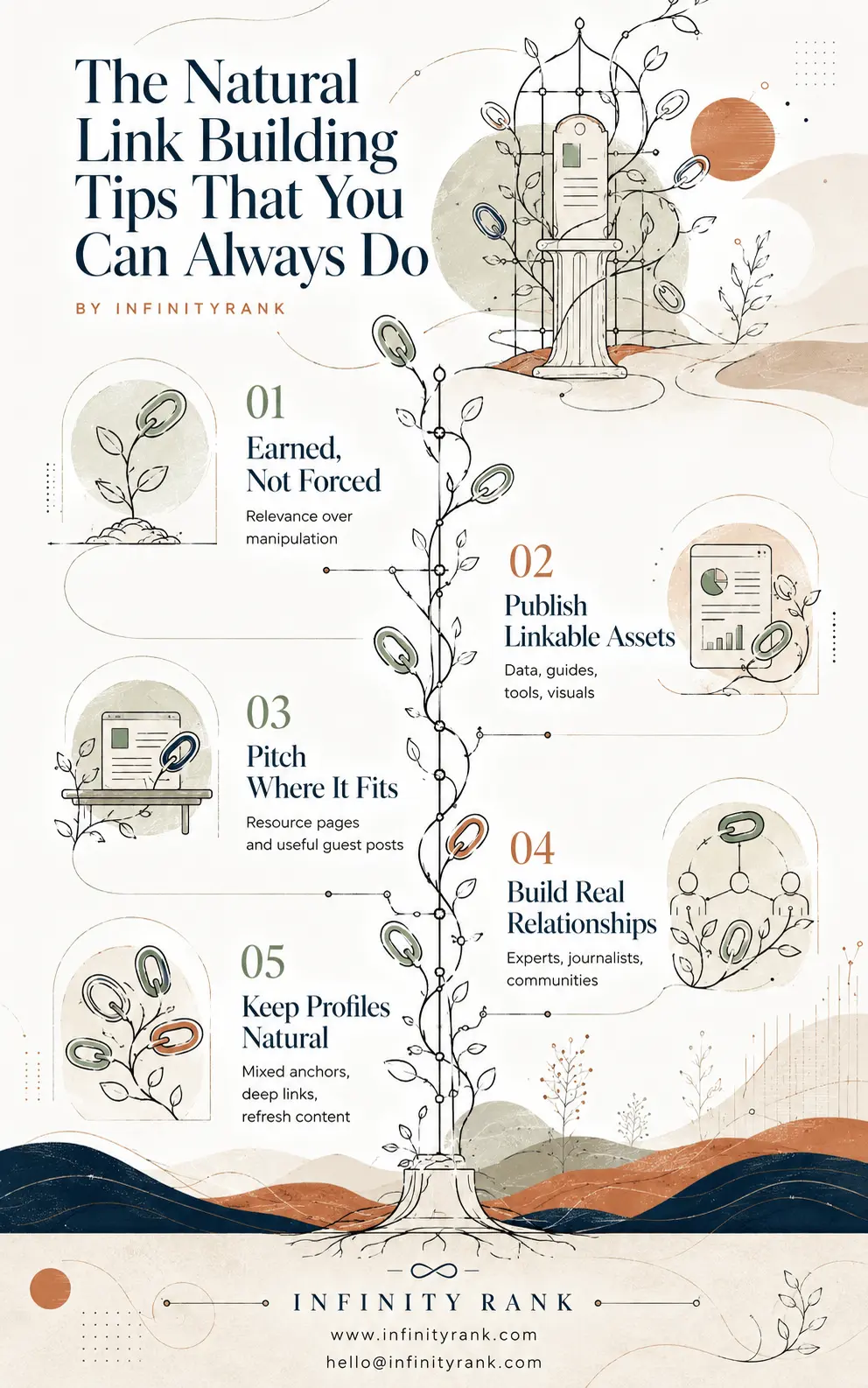
Sustainable growth is built on relevance, not manipulation. By prioritizing high-value assets and genuine industry connections, you create a backlink profile that Google trusts implicitly. Use the-natural-link-building-tips-that-you-can-always-do-infographic as a quality checklist to keep your outreach strategy clean and impactful.
What Is Natural Link Building?
Natural link building is the process of earning backlinks from relevant websites because your page deserves to be cited.
A natural backlink usually has these qualities:
- It appears in relevant editorial content.
- It points to a useful page, not just a sales page.
- It uses natural anchor text.
- It comes from a site with a real audience.
- It is not forced, hidden, paid without disclosure, or added only to manipulate rankings.
A natural link profile does not mean every link is perfect. It means your backlinks come from varied, relevant, and defensible sources.
Why a Natural Link Profile Matters
A natural backlink profile helps your site build authority without creating obvious spam patterns.
A healthy link profile usually includes:
- Branded anchors: “Infinity Rank”
- URL anchors:
infinityrank.com - Generic anchors: “read this guide,” “learn more”
- Descriptive anchors: “natural link building tips”
- Mixed source types: blogs, media sites, podcasts, resource pages, communities, and industry publications
- Deep links: backlinks pointing to useful internal pages, not only the homepage
The risk comes from patterns.
For example, if 100 backlinks use the same exact-match anchor from unrelated guest posts, that does not look organic. It looks engineered. Anchor diversity alone will not protect a weak campaign, but it reduces obvious unnatural patterns.
1. Publish Content Worth Linking To
The strongest natural link building strategy is still simple: create pages that other websites have a reason to cite.
Most websites do not link to generic blog posts. They link to assets that make their own content better.
Good linkable assets include:
- Original research
- Industry surveys
- Data studies
- Case studies
- Free templates
- Calculators
- Checklists
- Visual explainers
- Statistics pages
- Expert roundups
- Step-by-step guides
Weak example:
“10 SEO Tips for Small Businesses”
Better example:
“Small Business SEO Benchmarks: Traffic, Conversion, and Link Data From 500 Local Websites”
The second one has data. Writers, journalists, and bloggers can cite it.
How to make content more linkable
Before publishing, ask:
- Does this page include information people cannot easily find elsewhere?
- Does it include original examples, data, or expert input?
- Would another writer cite this page to support a claim?
- Is the page better than the top-ranking competing pages?
- Is there a clear reason for someone to link to it?
If the answer is no, the page is probably not a linkable asset. It may still rank, but it will not naturally attract many backlinks.
2. Use Guest Posting Carefully
Guest posting can still work, but only when it is relevant, editorial, and useful.
Bad guest posting is easy to spot. It usually involves low-quality sites, recycled content, exact-match anchors, and articles written only to place a backlink.
That is not natural link building.
A safer guest posting approach looks like this:
- Pitch websites in your niche or adjacent industries.
- Offer a topic their audience actually needs.
- Write original content with examples and useful takeaways.
- Link only where the backlink genuinely helps the reader.
- Avoid forcing keyword-rich anchor text.
- Use
sponsoredornofollowwhere the placement is paid or promotional.
Google specifically warns against links in articles, guest posts, or press releases distributed on other sites when they use optimized anchor text at scale.
So the rule is simple: guest post for audience and authority first. Treat the link as secondary.
3. Earn Links From Resource Pages
Resource pages exist to link to useful content. That makes them one of the cleaner natural link building opportunities.
Examples of search operators:
intitle:resources + [your topic][your topic] useful resources[your topic] recommended tools[your topic] helpful guides[industry] links[topic] reading list
Do not pitch every page you find. Filter first.
A good resource-page target should be:
- Relevant to your niche
- Recently updated
- Linked from a real website, not a link farm
- Useful to its audience
- Not overloaded with spammy outbound links
Your pitch should be short. Do not beg. Do not over-explain.
Example:
Hi [Name],
I found your resource page on [topic]. You already link to several helpful guides, so I thought this might be a useful addition: [Page Title].
It covers [specific value], including [data/template/example].
Might be worth adding if you think it helps your readers.
Your link only fits naturally if your page is genuinely useful enough to belong there.
4. Build Relationships Before You Need Links
Links come from people. That part gets ignored too often.
If editors, founders, journalists, bloggers, and creators know your brand, they are more likely to mention your work when it is relevant.
Ways to build link-earning relationships:
- Comment thoughtfully on industry posts.
- Share other people’s work with useful context.
- Invite experts to contribute quotes.
- Join niche Slack, Discord, LinkedIn, and newsletter communities.
- Collaborate on webinars or podcasts.
- Send useful data to writers before pitching for links.
- Build a private list of journalists and bloggers who cover your topic.
This is slower than cold outreach. It is also more durable.
Cold outreach asks for attention. Relationship-based outreach earns it.
5. Respond to Journalist and Source Requests
Digital PR is one of the best ways to earn natural backlinks from authoritative sites.
Journalists often need expert quotes, statistics, and commentary. If your response is useful, they may cite you and link to your website.
Useful platforms and methods include:
- HARO
- Qwoted
- Featured
- SourceBottle
- Help a B2B Writer
- Direct journalist outreach
- X and Bluesky journalist requests
- Industry newsletters
Important update: HARO was rebranded as Connectively, shut down in December 2024, and later returned under new ownership in 2025. Do not rely on one platform only. Use several source-request channels.
How to write better journalist responses
Bad response:
I’m an SEO expert and can comment on this.
Better response:
Most small businesses fail at link building because they chase domain authority instead of relevance. A backlink from a niche industry blog with real buyers is often more useful than a generic high-DA site with no topical fit.
Journalists need quotable answers. Give them something specific, clear, and non-generic.
6. Refresh Old Content to Earn New Links
Old content can still attract backlinks if it is updated properly.
Most websites publish content and forget it. That creates an opening. If your guide is newer, more accurate, and more useful than competing pages, you have a stronger reason to pitch it.
Refresh old content by adding:
- Updated statistics
- New screenshots
- Better examples
- Expert quotes
- New sections based on search intent
- Original visuals
- FAQ answers
- Internal links
- Better title tags and meta descriptions
Then promote the updated page.
Do not just change the year in the title. That is thin updating. Actually improve the content.
7. Create Visual Assets People Can Embed
Visual assets earn links because they save other publishers time.
Strong visual link assets include:
- Infographics
- Flowcharts
- Comparison tables
- Process diagrams
- Maps
- Timelines
- Data charts
- Checklists
For example, an article about link building could include a visual checklist showing:
- Relevance
- Editorial placement
- Anchor type
- Link destination
- Traffic potential
- Spam risk
- Link attribute
Add an embed code below the asset. That makes it easier for bloggers and editors to reuse the visual while crediting your site.
Keep visuals evergreen. Avoid trendy designs that look outdated in six months.
8. Use Unlinked Brand Mentions
Sometimes websites mention your brand but do not link to you. That is an easy natural link opportunity.
How to find unlinked mentions:
- Search Google for your brand name.
- Use tools like Ahrefs, Semrush, or Brand24.
- Check news mentions.
- Monitor podcast pages.
- Look for quoted expert contributions.
- Track misspellings of your brand name.
Then send a simple request.
Example:
Hi [Name],
Thanks for mentioning Infinity Rank in your article on [topic]. Could you link the mention to our website so readers can find the source more easily?
This works because the mention already exists. You are not forcing a new backlink into unrelated content.
9. Get Listed in Relevant Directories and Industry Pages
Directories are not automatically bad. Bad directories are bad.
A relevant directory can still be useful if it helps real users find businesses, tools, or experts in a specific niche.
Good directory examples:
- Local chamber of commerce listings
- Industry association member pages
- SaaS directories
- Partner pages
- Podcast guest directories
- Event sponsor pages
- University or nonprofit resource lists
Avoid directories that:
- Accept every website
- Have no editorial review
- Exist only to sell links
- Cover unrelated industries
- Have spammy outbound links
- Promise ranking improvements
Directory links should support trust and discovery. They should not be your main link building strategy.
10. Keep Anchor Text Natural
Anchor text matters, but trying to control it too aggressively creates risk.
Natural anchor text varies because different people link in different ways.
A healthy anchor mix may include:
- Brand name
- Naked URL
- Page title
- Partial-match phrases
- Generic phrases
- Long descriptive phrases
Bad anchor pattern:
“best link building agency” repeated across dozens of guest posts
Better anchor pattern:
“Infinity Rank,” “this link building guide,” “their case study,” “natural link building tips,” and the raw URL
Do not demand exact-match anchors from every publisher. That is one of the fastest ways to make a link profile look manipulated.
Natural Link Building Mistakes to Avoid
Avoid these mistakes:
- Building links from irrelevant websites
- Repeating the same exact-match anchor
- Buying links that pass ranking credit without disclosure
- Using guest posts only for backlinks
- Submitting to low-quality directories
- Linking only to your homepage
- Ignoring nofollow, sponsored, and UGC attributes
- Publishing generic content nobody would cite
- Sending mass outreach with no personalization
- Measuring link quality only by domain authority
Natural link building is not risk-free. It is risk-controlled.
Natural Link Quality Checklist
Before pursuing a link, check:
- Is the website topically relevant?
- Does the site have a real audience?
- Is the page indexed?
- Is the content edited by a real person?
- Does the link make sense in context?
- Is the anchor text natural?
- Are outbound links clean and relevant?
- Is the page overloaded with paid links?
- Would you still want the link if Google ignored it?
- Does the link send qualified referral traffic?
That last question matters. If the link has no value outside SEO, it is probably not a strong link.
Simple Outreach Template for Natural Links
Use this structure:
Subject: Resource suggestion for [Page Topic]
Hi [Name],
I found your page on [topic] while researching [specific angle].
You already included some useful resources, especially [mention one existing resource].
I thought this guide may also be useful for your readers: [Page Title]
It covers [specific benefit], including [data/template/example].
No pressure, but it may be a good fit for the section on [specific section].
Best,
[Your Name]
Why this works:
- It is short.
- It proves you reviewed the page.
- It explains why your link belongs.
- It does not demand a keyword anchor.
- It gives the editor an easy decision.
Conclusion
Natural link building is not about shortcuts. It is about earning links that make sense.
The best links come from useful content, relevant relationships, expert commentary, refreshed assets, resource pages, and brand mentions. These methods take more effort than buying placements or blasting guest-post pitches, but they build a cleaner and more defensible backlink profile.
Focus on relevance. Keep anchors natural. Avoid manipulative patterns. Create assets worth citing.
That is how natural link building still works in 2026.
FAQs
What are natural backlinks?
Natural backlinks are links earned because another website finds your content, brand, data, or expertise useful enough to reference. They are not forced, hidden, or placed only to manipulate rankings.
How do I make backlinks look natural?
Do not focus on making backlinks “look” natural. Focus on earning relevant links from real websites. Use varied anchors, build links to useful pages, and avoid repeated patterns.
Is guest posting natural link building?
Guest posting can be part of natural link building if the content is useful, relevant, and editorially approved. It becomes risky when it is done at scale with keyword-rich anchors or paid placements that are not disclosed.
What is the safest natural link building strategy?
The safest strategy is publishing link-worthy assets, such as original research, templates, calculators, statistics pages, and expert guides. These give other websites a real reason to cite you.
Do natural backlinks improve SEO?
Yes, natural backlinks can support SEO by strengthening authority, trust, and topical relevance. They work best when they come from relevant websites and point to useful content.
How many natural backlinks do I need?
There is no fixed number. A local business may need fewer quality links than a national SaaS brand. Focus on relevance, authority, and consistency instead of chasing a backlink count.
Are directory backlinks natural?
Directory backlinks can be natural if the directory is relevant, selective, and useful to real users. Low-quality directories that accept every website are not worth pursuing.
Should paid links use nofollow or sponsored tags?
Yes. Paid, sponsored, or promotional links should be qualified properly with attributes like rel="sponsored" or rel="nofollow" according to Google’s outbound link guidance.