Expanding into a new country takes more than translating your website or launching a localized landing page.
Search engines still need proof that your business belongs in that market. That proof comes from several places: localized content, technical SEO, hreflang setup, local search signals, and backlinks from relevant websites in the target country.
This is where many international SEO campaigns fall short. They build a few generic links, translate existing content, and expect the same strategy to work in every market. It usually does not. Each country has different competitors, publishers, directories, search behavior, and outreach expectations.
Before choosing tactics, you need to understand what international SEO link building actually means and how it differs from regular link building.
What Is International SEO Link Building?
International SEO link building is the process of earning backlinks from relevant websites in the countries, regions, and languages you want to rank in.
It is not just regular link building translated into another language.
A link from a trusted website in your target market can help search engines understand that your brand is relevant to users in that location. It can also send qualified referral traffic from people who actually live, search, shop, and make decisions in that market.
For example, if your business wants to rank in Australia, links from Australian publications, local business associations, industry blogs, universities, event sites, or trusted directories are usually more useful than random links from unrelated websites in other countries.
The goal is not to collect as many links as possible. The goal is to earn relevant, local, trustworthy links that support your international SEO strategy.
Why International Links Matter
Google uses links to discover pages and understand relationships between websites. Links are also one of several signals that can help search engines evaluate relevance and authority.
For international SEO, links can support three important goals:
- Market relevance
Links from websites in your target country help reinforce that your business is relevant to that region. - Topical authority
Links from industry-specific websites show that your content belongs in that niche. - Referral traffic and trust
Local links can send visitors who are more likely to understand your offer, currency, shipping options, language, and market context.
A strong international link-building strategy should work alongside hreflang, localized content, country targeting, technical SEO, and market-specific keyword research. Links alone will not fix a weak international SEO setup.
International SEO: Scaling Global Authority
Expanding your digital footprint across multiple borders requires more than just translating your existing content; it demands a fundamental shift in how you build authority. A backlink strategy that dominates your local market can completely fall flat in another country if you ignore localized search behavior, regional domain preferences, and cultural nuances. To rank effectively in foreign search engines, you must secure links that signal native relevance.
This international SEO link-building strategy outlines four essential pillars to help you scale your brand’s global visibility safely and predictably.
Succeeding on a global scale is about building trust within each specific target region, one relevant connection at a time. By balancing ccTLDs with localized content, you protect your site from algorithm shifts and establish a genuine regional presence.
Use the international-seo-link-building-infographic as your foundational roadmap to plan your next cross-border campaign.
1. Analyze Local Competitors First
Do not start outreach blindly.
Start by identifying the websites already ranking in your target country. These are your real competitors in that market, not always the same competitors you see in your home country.
Search your main keywords using the local version of Google, such as:
- Google.com.au for Australia
- Google.co.uk for the United Kingdom
- Google.ca for Canada
- Google.de for Germany
- Google.fr for France
Then review the top-ranking pages and export their backlink profiles using tools like Ahrefs, Semrush, Moz, or Majestic.
Look for patterns:
- Which local publications link to them?
- Which directories list them?
- Which bloggers, associations, or partners mention them?
- Are they earning links from local news, events, sponsorships, or resource pages?
- Do they have links from universities, chambers of commerce, or trade bodies?
This gives you a realistic link prospect list based on what already works in that market.
Do not copy every competitor link. Some links will be weak, paid, irrelevant, or risky. Use competitor research to find opportunities, not to duplicate spam.
2. Get Listed in Trusted Local Directories
Local directories can help, but only when they are relevant and trusted.
A good local directory should have real users, editorial standards, clear business categories, and relevance to your target country or industry.
Examples include:
- Local chambers of commerce
- Industry associations
- Trade directories
- Regional startup directories
- Local supplier databases
- Professional membership sites
- Niche marketplaces
Avoid low-quality directories that exist only to sell links. Google’s spam policies warn against low-quality directory links and links created mainly to manipulate rankings.
Before submitting your site, check:
- Is the directory relevant to your country or niche?
- Does it rank for real search terms?
- Are listed businesses legitimate?
- Are the listings moderated?
- Is the site full of spam, casino links, adult links, or unrelated categories?
- Would a real customer use this directory?
A directory link should make sense even if SEO did not exist.
3. Localize Content Before Outreach
Translation is not enough.
If your article, landing page, or resource feels foreign to local readers, outreach will fail. Local publishers want content that feels useful to their audience.
Localization means adapting your content to the market.
That includes:
- Local spelling and terminology
- Local statistics
- Local laws or regulations
- Local currency
- Local examples
- Local customer pain points
- Local competitors
- Local cultural context
For example, an article targeting the UK should not use only US pricing, US spelling, and US examples. A German audience may expect more detail, stronger evidence, and a more formal tone. A Japanese audience may respond better to trust signals, credentials, and careful wording.
Localized content earns better links because it gives local websites a real reason to reference it.
Weak pitch:
We wrote a guide about ecommerce SEO. Please link to it.
Better pitch:
We created a Germany-specific ecommerce SEO checklist covering hreflang, VAT considerations, localized product pages, and German marketplace visibility. It may be useful for your readers building cross-border stores.
The second pitch gives the publisher a reason to care.
4. Use Country-Specific Digital PR
Digital PR is one of the strongest ways to earn international links.
The mistake most companies make is sending the same press release to every country. That rarely works.
Each market needs a local angle.
Examples:
- A data study comparing consumer behavior in one country
- A report about local ecommerce growth
- A survey of local business owners
- A regional hiring or salary report
- A trend report specific to one industry in one country
- A map, calculator, or tool built for local users
Journalists and bloggers need stories that fit their audience. A generic global announcement is usually too broad. A local data point is easier to cover.
For example:
Weak angle:
Our company launched a new SEO service.
Stronger angle:
New analysis shows Australian ecommerce brands lose visibility because their international pages lack localized backlinks.
The second angle gives local media a specific reason to mention the study.
5. Build Relationships With Local Publishers and Influencers
International link building depends heavily on trust.
Cold outreach can work, but it works better when the pitch is written in the local language, follows local etiquette, and clearly explains why the content matters to that audience.
Good prospects include:
- Local bloggers
- Industry newsletter owners
- Podcast hosts
- Journalists
- Trade publication editors
- Local influencers
- University resource page managers
- Community site owners
- Event organizers
Do not send generic mass emails.
Personalize the pitch around:
- Their audience
- Their recent content
- The local angle
- Why your resource is useful
- What makes your content credible
Example outreach email:
Subject: Local resource for your article on cross-border ecommerce
Hi [Name],
I saw your article on [topic] and noticed you covered the challenges of selling into [country].
We recently published a [country]-specific guide on international SEO for ecommerce brands. It includes localized keyword research, hreflang checks, backlink prospecting, and common mistakes brands make when entering [market].
It may be a useful reference for your readers here: [URL]
Either way, I appreciated your breakdown of [specific points from their article].
Best,
[Name]
This is simple, relevant, and not pushy.
6. Use ccTLDs and Local Domains Carefully
Country-code top-level domains, or ccTLDs, can provide clear geographic signals. Examples include:
- .
co.uk .com.au.de.fr.ca.jp
A link from a relevant local website can be valuable, but do not assume that a ccTLD automatically makes a link high quality.
A strong link from a trusted .com site with a clear local audience may be more useful than a weak link from a spammy ccTLD.
Evaluate the full context:
- Is the website relevant to the target country?
- Is the site topically relevant?
- Does it have real traffic?
- Is the link editorial?
- Is the page indexed?
- Is the surrounding content useful?
- Is the anchor text natural?
- Is the website trusted by local users?
ccTLDs can help with local relevance, but quality and context still matter most.
7. Earn Links Through Local Partnerships
Partnerships are often overlooked because they take more effort than cold outreach. That is exactly why they can work.
Strong local partnership opportunities include:
- Sponsoring local events
- Speaking at local webinars
- Joining local business groups
- Partnering with universities
- Publishing joint research
- Supporting nonprofit initiatives
- Collaborating with local creators
- Offering expert quotes to local media
- Creating scholarships or training programs
But there is a compliance issue: if a link is paid, sponsored, or part of a commercial arrangement, it should use the proper link attribute, such as rel="sponsored" or rel="nofollow".
Do not use sponsorships as a disguised paid-link scheme. That can create SEO risk.
A legitimate partnership should provide value beyond the backlink.
How to Qualify International Link Prospects
Not every link is worth pursuing.
Use this checklist before adding a website to your outreach list:
| Check | What to Look For |
| Country relevance | The site serves users in your target market |
| Topical relevance | The content fits your niche or industry |
| Editorial quality | The site publishes useful, human-written content |
| Organic visibility | The site ranks for real keywords |
| Traffic quality | The audience matches your target customers |
| Link context | The link would appear naturally inside relevant content |
| Spam risk | Avoid link farms, PBNs, fake directories, and spun content |
| Anchor text | Use natural branded or contextual anchors |
| Link attribute | Sponsored links should be marked properly |
| Business value | The link could send real referral traffic |
A link that looks good in a spreadsheet but has no real audience, no relevance, and no editorial value is not worth chasing.
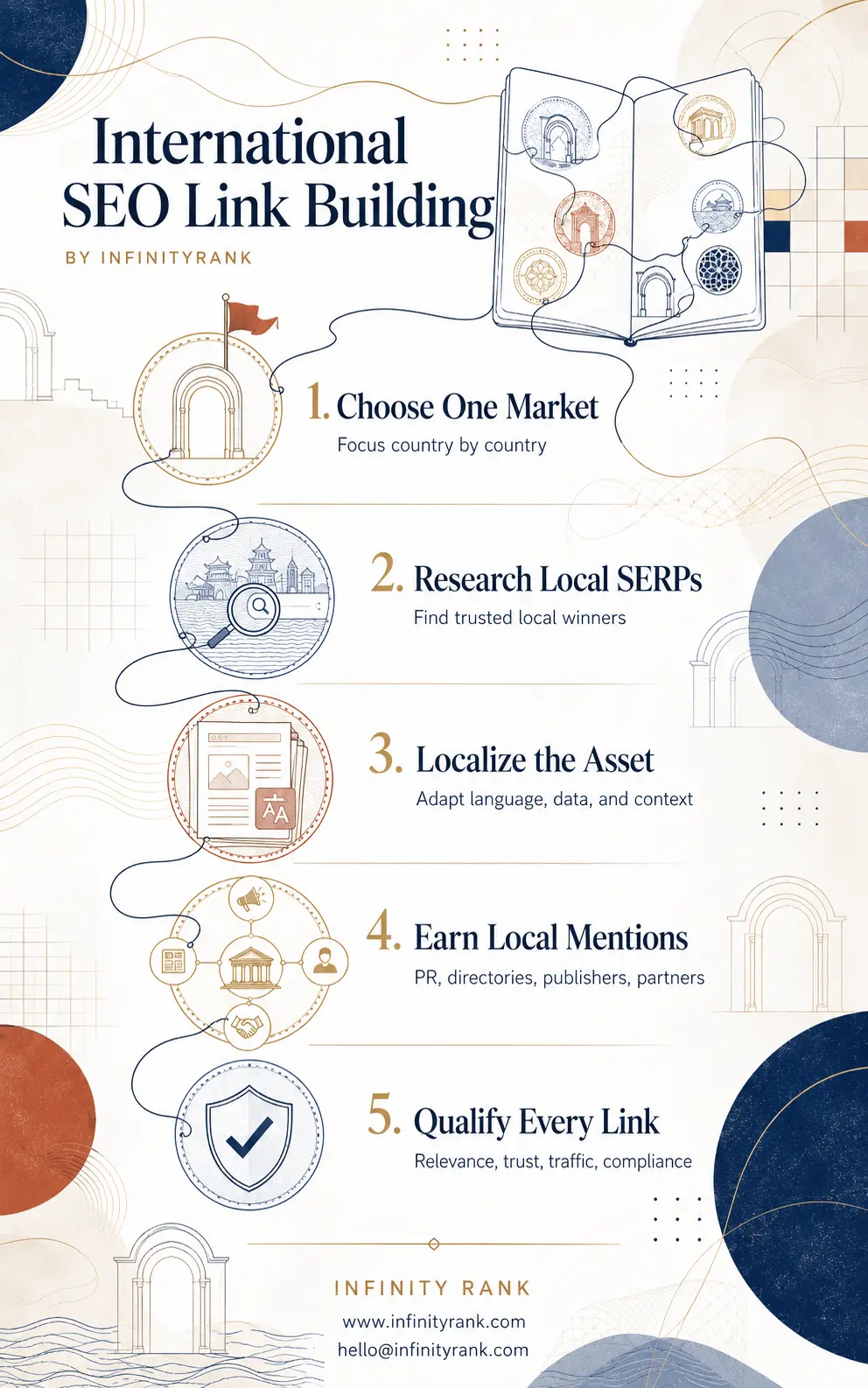
International Link-Building Workflow
Use this process:
- Choose the target market
Pick one country or language market at a time. Do not try to build links globally with one generic campaign. - Research local SERPs
Search target keywords in the local version of Google. Identify who ranks and what kind of content earns links. - Export competitor backlinks
Use backlink tools to collect referring domains from top-ranking competitors. - Filter prospects
Remove spam, irrelevant sites, low-quality directories, and obvious paid-link networks. - Create localized assets
Build content worth linking to: guides, reports, tools, templates, statistics, or local resources. - Write local outreach
Use the correct language, tone, and context for the market. - Track results
Measure referring domains, rankings, referral traffic, conversions, and anchor text distribution. - Repeat by market
Do not reuse the exact same strategy in every country. Each market has different publishers, search behavior, and trust signals.
Metrics to Track
International link building should be measured by more than link count.
Track:
- Referring domains by country
- Links from country-relevant websites
- Links from topically relevant websites
- Local keyword rankings
- Organic traffic by country
- Referral traffic from earned links
- Assisted conversions
- Anchor text distribution
- Follow, nofollow, and sponsored link mix
- Indexed localized pages
- Link acquisition cost
- Outreach reply rate
- Link quality by campaign
A campaign that earns five strong local links may outperform a campaign that earns fifty weak international links.
Common International Link-Building Mistakes
Translating Content Without Localizing It
A translated article can still feel irrelevant. Add local examples, data, terminology, and search intent.
Using the Same Outreach Email Everywhere
A pitch that works in the US may fail in Germany, Japan, France, or the UAE. Local tone matters.
Chasing Any ccTLD Link
A local domain extension does not automatically mean the website is trustworthy or useful.
Relying on Low-Quality Directories
Directory links can help when the directory is real and relevant. Spam directories can hurt trust and waste budget.
Ignoring Sponsored Link Rules
Paid placements, sponsorships, and advertorials should use proper link attributes.
Over-Optimizing Anchor Text
Do not force exact-match anchors in every country. Use branded, natural, and contextually relevant anchor text.
Running One Global Campaign
International SEO works best when each country has its own strategy, content, prospect list, and outreach angle.
FAQs About International SEO Link Building
What is international SEO link building?
International SEO link building is the process of earning relevant backlinks from websites in the countries, regions, or languages your business wants to rank in.
Are country-specific backlinks important?
Yes, but quality matters more than country alone. A relevant local link from a trusted website is useful. A spammy local link is not.
Do I need links from ccTLD domains?
Not always. ccTLD links can help with country relevance, but links from trusted local publishers on other domain types can also be valuable.
Should I build links in every target country?
Yes, if each country is an important SEO market. A single global backlink profile may not be enough to compete in local search results.
Can translated content earn backlinks?
It can, but localized content performs better. Publishers are more likely to link to content that uses local examples, data, and terminology.
Are directory links safe?
Some are. Trusted local directories, industry associations, and business groups can be useful. Low-quality directories built only for SEO should be avoided.
How long does international link building take?
Most campaigns take months, not days. You need time for research, content localization, outreach, relationship building, and link acquisition.
Final Thoughts
International SEO link building is not about collecting random backlinks from different countries.
It is about proving local relevance.
To do that, you need market-specific research, localized content, trusted local prospects, careful outreach, and clean compliance practices.
Start with one priority country. Study the local SERPs. Build a prospect list from real competitors. Create content that fits the market. Then earn links from websites that local users and search engines can trust.
That is how international link building supports long-term global SEO growth.