Not every backlink is worth chasing.
Some links come from thin blogs, spammed directories, expired domains, or sites with no real audience. They may increase your backlink count, but they rarely build lasting search visibility. Worse, some can put your site at risk if they are part of manipulative link schemes.
Authority link building is different. It focuses on earning links from trusted, relevant websites that have real editorial standards, real readers, and real topical connection to your business.
Google uses links to discover pages and understand relevance, but links are only one part of a much larger ranking system. Google’s own documentation says its ranking systems look at many factors and signals, not one simple metric. That means authority link building works best when it supports strong content, technical SEO, and a clear topical strategy.
This guide explains what authority link building is, what makes a link valuable, how to find better link opportunities, and how to build links without relying on risky shortcuts.
Authority Links: Fake or Real?
Chasing third-party authority metrics like Domain Authority (DA) or Domain Rating (DR) has led thousands of brands into a trap, spending premium budgets on inflated, non-indexed sites that offer zero ranking power. True authority cannot be simulated by software; it is earned through genuine topical relevance, consistent organic search presence, and editorial moderation.
When your campaign shifts toward acquiring placements that search engines actually trust, your site achieves long-term structural resilience. This advanced credibility roadmap uncovers four critical filters required to identify and secure links from real digital powerhouses.
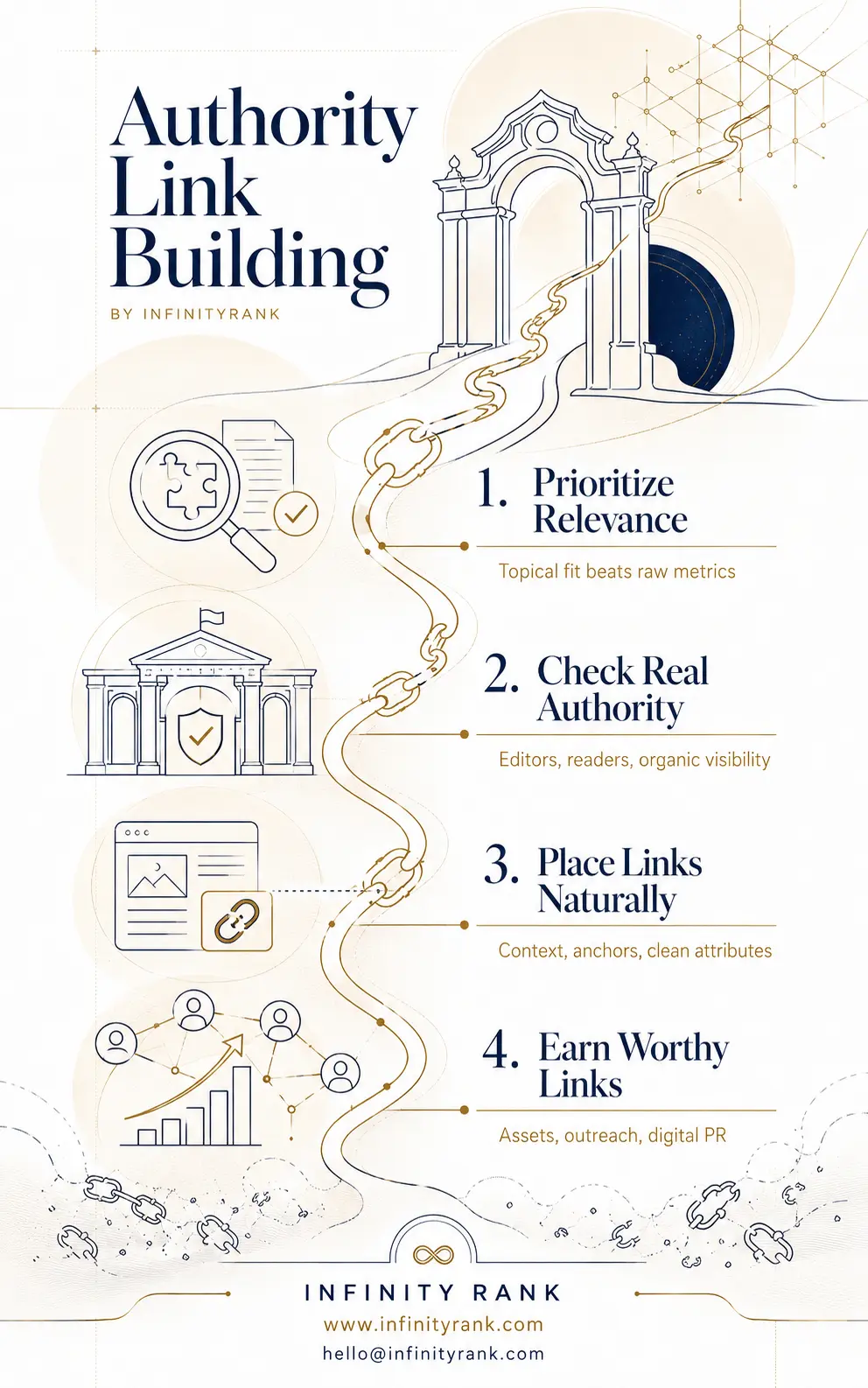
Securing true authority is about stepping away from easily manipulated metrics and focusing on real-world search performance. By insisting on strict editorial standards, contextual integrity, and tight topical alignment, you position your domain at the top of competitive search results. Use the authority-link-building-infographic as your foundational quality checklist to vet your targets before launching your next campaign.
What Is Authority Link Building?
Authority link building is the process of earning backlinks from trusted, established, and relevant websites in your industry.
A strong authority link usually comes from a website that:
- Covers topics closely related to your niche
- Has a real audience
- Publishes useful editorial content
- Ranks for relevant keywords
- Has a clean outbound link profile
- Links naturally within helpful content
- Uses descriptive anchor text
- Is crawlable and indexable
The key word is relevant.
A backlink from a huge national publication may look impressive, but it is not automatically better than a link from a smaller industry publication that your audience actually reads. For SEO, topical relevance matters. A real estate business, for example, may get more value from a link on a respected property investment site than from a generic lifestyle blog with a higher third-party authority score.
Authority link building is not about collecting the highest DA or DR numbers. Those metrics can help with screening, but they are not Google’s scoring system. Treat them as rough indicators, not proof that a link is valuable.
Why Authority Links Still Matter
Authority links matter because they can support three important SEO outcomes: discovery, relevance, and trust.
Google’s link documentation says links help Google find pages and understand what linked pages are about. It also recommends making links crawlable and using anchor text that helps users and Google understand the destination page.
A good authority backlink can help your SEO in several ways:
1. Stronger topical signals
When a respected website in your industry links to your content, it helps reinforce the topic your page is associated with. This is especially useful when the linking page, surrounding text, and anchor text are all relevant.
2. Better referral traffic
Authority links are not just for rankings. A link from a site with a real audience can send qualified visitors directly to your page. That traffic is often more valuable than traffic from random blogs built only to sell links.
3. Higher brand credibility
Being mentioned by trusted publications, associations, partners, or industry resources can make your brand look more credible to prospects. This matters in competitive niches where buyers compare multiple providers before contacting anyone.
4. Harder-to-copy advantages
Low-quality links are easy for competitors to copy. Strong authority links are harder to replicate because they usually require better content, stronger relationships, original data, or genuine expertise.
What Makes a Backlink Authoritative?
Do not judge a backlink by one number. A useful authority link should pass several quality checks.
Topical relevance
The linking website should make sense for your industry. The closer the connection, the better.
For example:
- A SaaS company should prioritize software, startup, product, and technology publications.
- A law firm should prioritize legal directories, bar associations, legal blogs, and local business publications.
- A dental clinic should prioritize health, local, dental, and community websites.
- A real estate company should prioritize property, finance, architecture, relocation, and local market sites.
A random high-DR blog about unrelated topics is not a strong authority link. It is just a metric with weak relevance.
Editorial standards
Good authority sites do not publish everything they receive. They review submissions, reject weak content, and protect their audience. That friction is a good sign.
Avoid websites that openly sell guest posts, publish thin AI content, accept every topic, or link out to casinos, adult sites, CBD, crypto spam, or unrelated businesses.
Real organic visibility
A site with real search traffic is usually more valuable than a site with inflated authority metrics but no rankings. Check whether the website ranks for relevant keywords, gets organic traffic, and has pages that are indexed.
Link placement
A link inside the main body of a relevant article is usually stronger than a footer, sidebar, author bio, or random resource dump. Context matters.
Anchor text
Anchor text should be descriptive but natural. Google recommends anchor text that helps users and search engines understand the linked page. Generic anchors like “click here” are weak, while over-optimized exact-match anchors can look manipulative.
Good examples:
- “link building services for SaaS companies”
- “study on local SEO ranking factors”
- “guide to technical SEO audits”
Bad examples:
- “click here”
- “best cheap link building agency”
- “buy backlinks now”
Clean link attributes
Paid, sponsored, affiliate, or advertising links should be qualified properly. Google says paid or sponsored links should use appropriate attributes such as rel="sponsored" or rel="nofollow".
Do not build a strategy around paid links that pretend to be editorial links. That is where risk starts.
Authority Link Building Process
Use this process instead of randomly emailing every website with a high authority score.
1. Define the Pages You Want to Strengthen
Start with the target page, not the prospect list.
Choose pages that are worth promoting:
- Service pages with commercial value
- Data studies
- Original research
- Industry guides
- Useful tools or templates
- Case studies with real numbers
- Comparison pages
- Local landing pages with strong content
Do not waste outreach on thin pages. If the content would not help the linking site’s audience, the pitch is weak before you send it.
Before outreach, ask:
- Is this page better than competing pages?
- Does it offer original insight?
- Is it clear, accurate, and current?
- Would an editor have a real reason to cite it?
- Is the page internally linked from relevant pages on your site?
If the answer is no, fix the page first.
2. Build a Prospect List Based on Relevance
Do not start with “sites with DA 70+.” Start with relevance.
Good prospect categories include:
- Industry blogs
- Trade publications
- Professional associations
- Local news sites
- Resource pages
- Partner websites
- Supplier websites
- Podcasts
- Universities or research hubs, where relevant
- Niche directories with editorial standards
- Journalists covering your topic
- Existing unlinked brand mentions
Use SEO tools to check authority, traffic, and link profile quality, but do not let the tool make the decision for you.
A lower-authority niche website with real readers can be better than a high-authority general website with no topical match.
3. Create Link-Worthy Assets
Authority sites need a reason to link.
The best linkable assets usually give editors something they cannot easily recreate. Examples include:
Original data
Run a survey, analyze public datasets, study industry pricing, compare trends, or publish internal findings. Original data gives journalists and bloggers something to cite.
Practical guides
A detailed guide can earn links when it solves a real problem better than competing pages. Thin “ultimate guides” do not work. The guide must actually be useful.
Tools and templates
Calculators, checklists, spreadsheets, and templates can attract links because they save people time.
Expert commentary
If you have real expertise, use it. Strong quotes, predictions, and explanations can earn links through journalist requests, digital PR, podcasts, and industry roundups.
Case studies
Case studies work when they include clear context, actions taken, and measurable results. Avoid vague claims. If you say traffic increased, show the time frame and explain what else changed.
4. Qualify Every Prospect Before Outreach
Bad prospecting wastes time and creates risk.
Use this checklist before pitching a site:
| Check | Good Sign | Red Flag |
| Relevance | Covers your niche or related topics | Publishes every topic imaginable |
| Traffic | Ranks for real keywords | No meaningful organic visibility |
| Editorial quality | Has useful, reviewed content | Thin, generic, spun, or AI-heavy posts |
| Outbound links | Links to credible sources | Links to spammy or unrelated sites |
| Link placement | Contextual links in body content | Footer/sidebar/sitewide links |
| Audience | Real readers, comments, shares, newsletter, community | Built only to sell guest posts |
| Indexation | Pages are indexed | Many pages missing from index |
| Risk | No obvious link-selling footprint | “Write for us” farm with paid packages |
If a site fails several checks, skip it.
5. Pitch With a Specific Reason
Generic outreach gets ignored.
Do not send this:
I found your website and think my article would be a great fit. Please link to it.
Send something specific:
I read your guide on B2B SaaS onboarding and noticed the section on activation metrics. We recently published a breakdown of onboarding benchmarks from 120 SaaS companies. It may add useful data to that section, especially the part on time-to-value.
A good pitch includes:
- The exact page you are referencing
- The specific section where your link fits
- Why your content improves the page
- One clear call to action
- No fake flattery
- No pressure
- No mass-template language
Editors do not owe you a link. Your job is to make the link useful for their readers.
6. Use Digital PR for Higher-Authority Mentions
Digital PR is one of the best ways to earn authority links because it gives publications something newsworthy.
Strong digital PR angles include:
- Industry survey results
- Trend reports
- Local data comparisons
- Expert reactions to news
- Cost studies
- Rankings based on transparent methodology
- Visual maps or calculators
- Consumer behavior research
The important part is methodology. If your data is weak, the campaign is weak. Explain where the data came from, how it was analyzed, and what limitations apply.
Digital PR is not guaranteed. Some campaigns fail. But when the angle is strong, it can earn links from sites that ordinary guest posting will never reach.
7. Reclaim Existing Authority Opportunities
Not every authority link requires a new campaign.
Start with easier wins:
Unlinked brand mentions
Find pages that mention your brand but do not link to your website. Ask the editor to add a link so readers can find the source.
Broken links
Find broken links on relevant industry pages. If your content is a good replacement, pitch it as a fix.
Partner links
Ask vendors, clients, associations, sponsors, or partners to list your company where it genuinely belongs.
Podcast and webinar pages
If your team appears on a podcast, webinar, or event page, ask for a link to the most relevant profile, service, or resource page.
Image and asset credits
If other websites use your charts, graphics, or original data, request proper attribution with a link.
8. Track Link Quality and SEO Impact
Do not measure authority link building by link count alone.
Track:
- Referring domains earned
- Topical relevance of linking sites
- Organic traffic to target pages
- Ranking movement for priority keywords
- Referral traffic from earned links
- Assisted conversions
- Branded search growth
- Anchor text distribution
- Link velocity
- Spam risk
Be careful with attribution. A page may improve after earning links, but rankings can also change because of content updates, technical fixes, internal links, algorithm updates, or competitor movement. Do not claim a ranking jump happened “purely” because of one or two backlinks unless you can prove it.
Authority Link Building Mistakes to Avoid
Chasing DA or DR only
High metrics do not guarantee a useful link. Relevance, traffic, placement, and editorial quality matter more.
Buying links without proper attributes
Paid links should be qualified. Google’s spam policies address links intended to manipulate rankings, including low-value content and artificial linking patterns.
Using exact-match anchors too often
A natural backlink profile includes branded anchors, partial-match anchors, URLs, and descriptive phrases. Exact-match anchors should not dominate.
Publishing weak guest posts
Guest posting is not automatically bad. Low-value guest posting at scale is the problem. If the article exists only to place a link, it is not a strong SEO asset.
Ignoring internal links
External authority links help more when your own site structure supports the target page. Add internal links from related pages so authority flows naturally through your site.
Building links to bad pages
A strong backlink cannot fix a weak page. If the page is thin, outdated, poorly written, or misaligned with search intent, improve the content first.
Authority Link Building vs Regular Link Building
Regular link building often focuses on getting more referring domains. Authority link building focuses on getting better referring domains.
| Regular Link Building | Authority Link Building |
| Prioritizes volume | Prioritizes quality and relevance |
| Often uses generic outreach | Uses specific, value-led outreach |
| May chase DA/DR only | Checks traffic, relevance, placement, and risk |
| Can include weak guest posts | Focuses on editorial links and useful assets |
| Short-term mindset | Long-term authority and brand value |
The goal is not to make your backlink profile look bigger. The goal is to make it stronger, safer, and harder for competitors to copy.
Final Thoughts
Authority link building is not about collecting random backlinks from sites with impressive metrics. It is about earning relevant, editorial links from websites that search engines and real people have a reason to trust.
Start with better content. Build assets worth citing. Prospect based on relevance. Pitch with a specific reason. Avoid paid-link shortcuts that create risk. Then measure results by traffic, rankings, referral value, and link quality—not just backlink count.
If you want stronger SEO, build links that would still be valuable even if ranking metrics did not exist. That is the standard most link building campaigns fail to meet.
Frequently Asked Questions
What is authority link building?
Authority link building is the process of earning backlinks from trusted, relevant websites with real audiences and editorial standards. These links are usually more valuable than links from random, low-quality sites.
Are authority links a Google ranking factor?
Links can help Google discover pages and understand relevance, but Google uses many ranking systems and signals. Authority links should support a complete SEO strategy, not replace strong content, technical SEO, and search intent alignment.
Is Domain Authority the same as Google authority?
No. Domain Authority, Domain Rating, and similar scores are third-party metrics. They can help screen websites, but they are not Google’s own ranking score.
What makes a backlink high quality?
A high-quality backlink is relevant, editorially placed, crawlable, surrounded by useful context, and published on a website with real audience value. The best links make sense for both users and search engines.
Are nofollow links from authority sites useful?
Yes, they can still be useful for referral traffic, brand visibility, and credibility. However, they should not be treated the same as editorial followed links for SEO value.
How many authority links do I need?
There is no fixed number. It depends on your niche, competition, existing authority, content quality, and target keywords. A few relevant authority links can be more useful than many weak links.
Is guest posting still good for authority link building?
Guest posting can work when the content is useful, relevant, and published on a real editorial site. It becomes risky when it is done at scale with thin content, exact-match anchors, or sites that exist mainly to sell links.
What is the safest way to build authority links?
The safest approach is to earn links through original content, digital PR, expert commentary, useful resources, partnerships, and relationship-led outreach. Avoid link schemes, mass guest posting, and paid links that are not properly qualified.