Web directory link building is not dead. Bad directory link building is.
Old-school SEO directories, mass-submission sites, and paid link farms are useless at best and risky at worst. But relevant, moderated, real-user directories can still help your business get discovered, earn referral traffic, strengthen local citations, and support a broader backlink profile.
The mistake is treating every directory listing as an “authority backlink.” That is lazy SEO. A good directory link should make sense even if Google ignored the link completely.
This guide explains how web directory link building works, when it is worth doing, how to avoid spam directories, and how to build directory links safely.
Directory Links: Spam or Asset?
Blasting your website across hundreds of low-quality, automated web directories is a relic of the past that is more likely to trigger a spam penalty than improve your rankings. However, abandoning directory submissions entirely means missing out on crucial local citations and highly targeted niche platforms that search engines rely on for verification.
The key lies in filtering out the noise and focusing exclusively on authoritative, human-curated platforms that add genuine contextual value to your business. This structured directory submission strategy highlights five essential quality checks to ensure your listings reinforce your domain’s credibility safely.

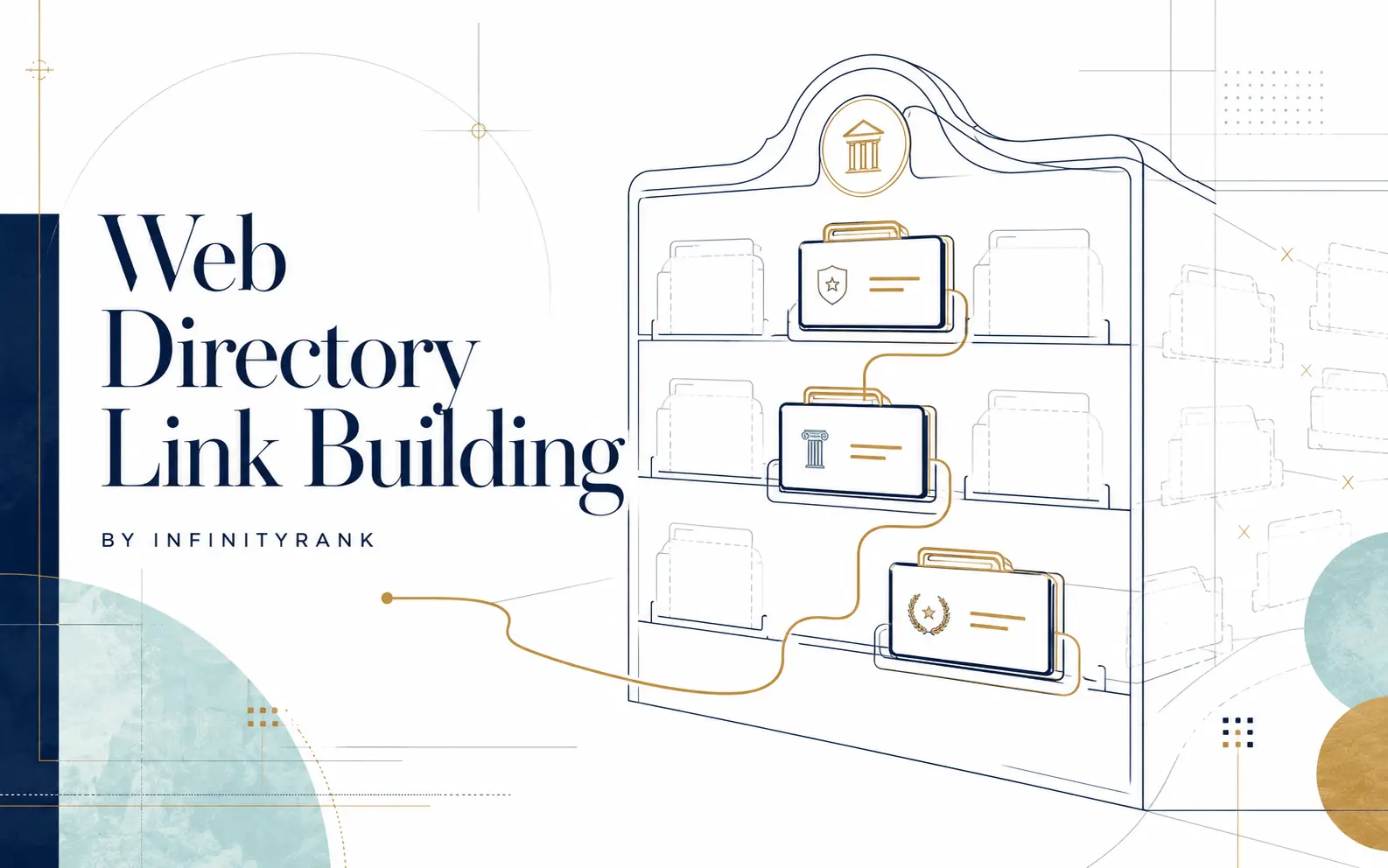
Navigating directory submissions requires strict filtering to prevent toxic links from diluting your hard-earned authority. By keeping your business data accurate and selecting only vetted platforms, you transform simple listings into a trusted layer of foundational brand signals. Use the web-directory-link-building-infographic as your strict evaluation checklist before submitting your site to any new platform.
What Is Web Directory Link Building?
Web directory link building is the process of getting your website listed on online directories that organize businesses, websites, tools, professionals, or resources by category.
A directory listing usually includes:
- Business or website name
- Website URL
- Description
- Category
- Location, if relevant
- Phone number and address for local businesses
- Social profiles
- Opening hours
- Reviews or ratings, depending on the platform
Examples include business directories, local citation sites, SaaS directories, legal directories, healthcare directories, agency directories, trade association directories, and niche resource lists.
The SEO value depends on the directory. A real directory with editorial standards, actual users, and topical relevance can support visibility. A generic “submit your URL” site with thousands of unrelated links is usually worthless.
Are Directory Links Still Useful for SEO?
Yes, but only in the right context.
Directory links are not a shortcut to rankings. They are a small part of a larger link building and entity-building strategy. Their main value is usually not raw link equity. Their real value comes from relevance, trust signals, referral traffic, and consistency across the web.
For local businesses, directories can also support citation consistency. Google says local ranking is based mainly on relevance, distance, and prominence, and it recommends keeping Business Profile information complete and accurate. Directory listings can support that wider local presence when your name, address, phone number, website, and category are consistent.
For non-local businesses, directories can still help when they are niche-specific. A SaaS company listed on a respected software directory, a law firm listed on a legal association site, or a contractor listed in a regional trade directory can gain qualified visibility.
The rule is simple: if the directory has no real users, no editorial review, no topical focus, and no reason to exist beyond selling links, skip it.
Directory Links vs Local Citations
Directory links and local citations overlap, but they are not the same thing.
A directory link focuses on the backlink from the directory to your website.
A local citation focuses on your business information being mentioned accurately across the web. That usually includes your business name, address, phone number, website, and category.
For local SEO, citation accuracy matters. Inconsistent phone numbers, outdated addresses, wrong business categories, and duplicate listings can confuse users and weaken trust. The backlink is secondary.
For example, a plumber in Brussels should care less about whether a directory link is “dofollow” and more about whether the listing shows the correct service area, phone number, hours, and category.
Good Directory Links vs Bad Directory Links
| Good Directory | Bad Directory |
| Relevant to your industry, location, or audience | Accepts every website in every niche |
| Has editorial review or moderation | Instant approval with no quality control |
| Receives real traffic or user engagement | Exists only to sell backlinks |
| Uses clear categories | Has messy, irrelevant categories |
| Displays complete business information | Shows thin listings with keyword-stuffed descriptions |
| Has clean outbound links | Links to gambling, adult, pharma, malware, or spam sites |
| Helps users compare or discover businesses | Provides no user value |
| Has a real brand or organization behind it | No clear owner, contact details, or standards |
A directory should pass the common-sense test. Would a potential customer, buyer, journalist, partner, or local user ever use it? If the answer is no, the listing is probably not worth your time.
Benefits of Web Directory Link Building
1. Better Online Visibility
A quality directory can put your business in front of people already looking for your type of service.
Examples:
- A local homeowner searching a contractor directory
- A founder comparing SaaS tools
- A patient looking through a healthcare provider directory
- A business owner browsing agency directories
- A journalist checking industry resource lists
This visibility has value even if the link is nofollow.
2. Referral Traffic
Directory links can send qualified visitors to your site. That matters more than chasing a dofollow link from a dead page.
A directory listing is useful when it drives users who are already close to taking action. For example, someone browsing “best immigration lawyers in Toronto” or “top Shopify development agencies” has higher intent than a casual blog reader.
Track referral traffic in Google Analytics. If a directory sends visits, leads, calls, or demo requests, it has business value.
3. Local SEO Support
For local businesses, directories can reinforce consistent business information across the web.
Your listings should match your Google Business Profile and website exactly:
- Business name
- Address
- Phone number
- Website
- Opening hours
- Service areas
- Business category
Do not use keyword-stuffed business names in directories unless that is your legal or real-world business name. It looks spammy and can create consistency problems.
4. Brand Trust
Being listed on respected directories, professional associations, local chambers, software marketplaces, and industry resource pages can support credibility.
This is not magic “Google trust.” It is basic brand validation. Users are more likely to trust a business that appears in relevant places across its industry.
5. Backlink Profile Diversification
A natural backlink profile usually includes different link types: editorial mentions, guest contributions, digital PR links, resource page links, citations, partner links, and some directory listings.
Directory links should never dominate your backlink profile. If most of your links come from low-quality directories, your link profile looks weak.
Are Paid Directory Links Saf e?
Paid directory listings are not automatically bad. Many legitimate directories charge for review, placement, verification, or membership.
The risk starts when the payment is mainly for a link that passes ranking signals.
Google’s spam policies state that buying or selling links for ranking purposes can be considered link spam. Paid links should be qualified with rel="nofollow" or rel="sponsored" when needed. Google also explains that rel="sponsored" is used for links created as part of advertisements, sponsorships, or compensation agreements.
So ask this before paying for a directory:
Would this listing still be worth buying if the link were nofollow?
If yes, it may be a valid marketing placement. If no, skip it.
How to Find High-Quality Directory Link Opportunities
Do not start with “free directory submission sites.” That search usually leads to junk.
Use targeted searches instead.
Search by Industry
Use queries like:
- best [industry] directories
- [industry] business directory
- [industry] association directory
- [industry] supplier directory
- [industry] software directory
- [industry] professional directory
Examples:
- legal association directory
- SaaS product directory
- wedding photographer directory
- construction company directory
- cybersecurity vendor directory
Search by Location
For local businesses, use location-based searches:
[city] business directory[city] chamber of commerce members[city] local business listings[city] [industry] directory[region] trade association directory
Examples:
Brussels plumber directoryToronto law firm directoryManchester electrician directoryNew York marketing agency directory
Search Competitor Listings
Check where competitors are listed.
Search:
"competitor brand name" "directory""competitor brand name" "profile""competitor brand name" "reviews""competitor brand name" "business listing"
You can also use backlink tools to find competitor directory links. Do not copy every listing blindly. Filter hard. Many competitor backlinks are junk.
Check Industry Associations
Association directories are often stronger than generic business directories because they usually have standards, membership requirements, and topical relevance.
Examples:
- Bar associations for lawyers
- Medical boards or healthcare directories
- Construction trade associations
- Local chambers of commerce
- SaaS marketplaces
- Partner directories
- Franchise directories
- Supplier and manufacturer directories
How to Vet a Directory Before Submitting
Use this checklist before creating a listing.
1. Relevance
The directory should match your industry, location, audience, or business type.
A local restaurant directory makes sense for a restaurant. A random global SEO directory with every category from casinos to dentists does not.
2. Editorial Standards
Good directories review submissions. Bad directories approve everything instantly.
Look for signs of moderation:
- Clear submission rules
- Human review
- Business verification
- Category standards
- No obvious spam listings
- No keyword-stuffed titles everywhere
3. Real User Value
Ask whether the directory helps users make decisions.
Useful directories often include:
- Reviews
- Filters
- Categories
- Locations
- Service descriptions
- Comparison features
- Contact options
- Verified profiles
If the page is just a list of blue links, it is probably weak.
4. Indexability
Check whether directory pages are indexed in Google. Search for the directory name and a few listing pages.
If Google does not index the listing pages, the SEO value is limited. It may still have referral value, but do not expect much organic impact.
5. Traffic Potential
Use SEO tools to estimate whether the directory gets organic traffic. Exact numbers are not perfect, but zero-traffic directories are rarely worth much.
Better signs:
- Ranking pages
- Branded searches
- Active categories
- Updated listings
- User reviews
- Recent activity
6. Outbound Link Quality
Look at other sites listed in your category.
Avoid directories that link heavily to spam niches, hacked-looking sites, doorway pages, adult sites, gambling sites, payday loans, or fake businesses.
You are judged by the neighborhood you choose.
7. Listing Quality
A good directory lets you build a useful profile. That includes a real description, services, images, contact details, and categories.
A poor directory only asks for anchor text and URL. That is a red flag.
How to Build Directory Links Safely
Step 1: Create a Master Business Profile
Before submitting anything, prepare a clean profile.
Include:
- Official business name
- Website URL
- Primary phone number
- Business email
- Address or service area
- Opening hours
- Short description: 50–75 words
- Long description: 150–250 words
- Main services
- Target locations
- Social links
- Logo
- Brand images
- UTM-tagged website URL, where appropriate
Keep this information consistent across all listings.
Step 2: Prioritize the Best Directories
Do not submit to 100 directories. That is not strategy. That is spam.
Start with:
- Google Business Profile, if local
- Major trusted business platforms relevant to your market
- Industry-specific directories
- Local chambers or regional business directories
- Professional association directories
- Partner or marketplace directories
- High-quality review platforms
Quality beats volume.
Step 3: Write Unique Descriptions
Do not paste the same keyword-stuffed paragraph into every directory.
Use a consistent core message, but adjust the description for the platform and audience.
Bad description:
Best SEO agency offering best SEO services, link building services, guest posting services, niche edits, blogger outreach, and best backlinks for SEO rankings.
Better description:
Infinity Rank is a link building agency that helps businesses earn relevant backlinks through manual outreach, niche edits, guest posting, digital PR, and content-led link acquisition. The team focuses on quality control, relevance, and sustainable link placement instead of bulk directory or spam submissions.
Clear beats stuffed.
Step 4: Choose the Right Category
Wrong categories hurt users and weaken relevance.
Pick the most specific accurate category available. If you are a SaaS company, do not choose “Business Services” if “Project Management Software” exists. If you are a drainage company, do not choose “Home Improvement” if “Drainage Services” exists.
Step 5: Use Natural Anchor Text
Most directory links use your brand name, URL, or business name. That is fine.
Avoid forcing exact-match commercial anchor text like:
- best link building agency
- cheap backlinks
- buy guest posts
- SEO services USA
Directory links with aggressive anchor text look unnatural.
Step 6: Track Every Listing
Create a simple spreadsheet with:
- Directory name
- URL
- Category
- Login email
- Submission date
- Approval status
- Listing URL
- Link type: follow, nofollow, sponsored, unknown
- NAP accuracy
- Referral traffic
- Notes
- Renewal cost, if paid
This prevents duplicate listings, forgotten renewals, and inconsistent business information.
Step 7: Review Listings Every 6–12 Months
Directories change. Listings break. Phone numbers change. Businesses move. Categories get updated.
Audit your listings at least once or twice a year. Fix outdated information quickly.
Directory Link Building Mistakes to Avoid
Submitting to Every Directory You Find
Mass submission is outdated. It creates a messy backlink profile and wastes time.
A few strong listings are better than hundreds of weak ones.
Using Exact-Match Anchor Text
Directory listings should usually use your brand name. Exact-match anchors across many directories are an obvious pattern.
Ignoring NAP Consistency
For local SEO, inconsistent name, address, and phone details create problems. Use the same format everywhere.
Paying Only for Dofollow Links
If the sales pitch is “pay us for a dofollow backlink,” be careful. That is usually a bad sign.
Pay for visibility, leads, verification, or membership. Do not pay just to manipulate rankings.
Listing on Irrelevant Sites
A SaaS brand does not need to be in a plumbing directory. A dentist does not need to be in a cryptocurrency directory.
Relevance matters.
Forgetting to Track Results
If you do not track referral traffic, leads, or ranking movement, you cannot judge value. Directory link building should be measured like any other SEO activity.
Best Directory Types by Business Model
Local Service Businesses
Use:
- Google Business Profile
- Local chamber of commerce
- City business directories
- Industry trade directories
- Review platforms
- Local contractor directories
Focus on accurate NAP, service areas, reviews, and categories.
SaaS Companies
Use:
- Software review platforms
- Product directories
- Integration marketplaces
- Startup directories
- Industry-specific tool lists
- Partner directories
Focus on product positioning, features, screenshots, use cases, and comparison intent.
Agencies
Use:
- Agency directories
- Partner directories
- Marketing service marketplaces
- Local business directories
- Industry awards directories
- Clutch-style review platforms
Focus on services, case studies, industries served, and client proof.
Ecommerce Brands
Use:
- Marketplace profiles
- Brand directories
- Retailer directories
- Manufacturer directories
- Niche shopping directories
- Sustainability or ethical brand directories, if relevant
Focus on product categories, brand story, trust signals, and customer reviews.
Professional Services
Use:
- Legal directories
- Medical directories
- Accounting directories
- Consultant directories
- Certification bodies
- Professional associations
Focus on credentials, licenses, locations, specialties, and contact accuracy.
How Many Directory Links Do You Need?
There is no fixed number.
For a local business, 20–50 accurate, relevant citations may be useful depending on the market, industry, and existing footprint.
For a SaaS company or agency, fewer high-quality niche listings may be enough.
The goal is not to hit a quota. The goal is to appear in the places your customers, partners, and search engines would reasonably expect to find you.
Once you have covered the obvious relevant directories, move on to stronger link building tactics like digital PR, original research, guest posting, resource page outreach, and linkable assets.
How to Measure Directory Link Building Results
Track more than backlinks.
Measure:
- Referral sessions
- Leads or form submissions
- Phone calls
- Branded search growth
- Local ranking movement
- Indexed listing pages
- Listing views, if the directory provides them
- Review activity
- Assisted conversions
- NAP consistency improvements
Directory links rarely create dramatic ranking jumps on their own. If a directory drives relevant traffic, improves citation consistency, and supports brand visibility, it is doing its job.
Web Directory Link Building Checklist
Before submitting to a directory, ask:
- Is it relevant to our industry, location, or audience?
- Does it have real users?
- Are listings reviewed or moderated?
- Are category pages indexed?
- Does the directory avoid obvious spam?
- Can we create a complete, useful profile?
- Would this listing be valuable without a dofollow link?
- Is the paid option based on visibility or just link selling?
- Can we use accurate NAP details?
- Can we track traffic or leads from it?
If the answer is mostly no, skip it.
Final Thoughts
Web directory link building still has a place in SEO, but only when it is selective, relevant, and user-focused.
Do not chase directory links because they are easy. Easy links are usually weak links. Build directory listings where they make sense for your business, your audience, and your local or industry presence.
A good directory listing should help people find, evaluate, and contact your business. If it also supports SEO, that is a bonus.
The safest approach is simple: choose quality over quantity, avoid spam directories, keep business information consistent, and never pay only for a link.
FAQs
Is web directory link building still effective?
Yes, but only with relevant and reputable directories. Generic directory submissions have little value and can make your backlink profile look low quality.
Are directory backlinks bad for SEO?
Not automatically. Directory backlinks become a problem when they come from spammy, irrelevant, low-quality, or paid link schemes. A listing on a legitimate industry or local directory is different from a mass-submission link farm.
Should directory links be dofollow or nofollow?
Do not obsess over dofollow links. A nofollow directory link can still send referral traffic and support brand visibility. Paid or sponsored links should be properly qualified according to Google’s link guidance.
How many directory links should I build?
There is no universal number. Build enough to cover the trusted, relevant directories in your industry or location. Stop when the remaining options are low quality.
What makes a directory high quality?
A high-quality directory is relevant, moderated, indexed, useful to real users, and free from obvious spam. It should provide more value than simply placing a link.
Can directory links help local SEO?
Yes, especially when they create accurate local citations. For local businesses, consistent business information across trusted platforms can support visibility and user trust. Google’s local ranking guidance emphasizes relevance, distance, prominence, and complete business information.