Enterprise link building is not the same as standard link building with a bigger budget.
For large brands, the challenge is not just getting backlinks. The challenge is earning the right links across a large website without creating SEO risk, wasting PR opportunities, duplicating outreach, or sending authority to the wrong pages.
A small business may only need links to a handful of service pages. An enterprise website may have thousands of URLs across product lines, locations, resource hubs, international sections, partner pages, and legacy content. That scale creates opportunity, but it also creates complexity.
Google still uses links to discover pages and understand relevance, but it also warns against link spam, including links created primarily to manipulate search rankings. That makes enterprise link building a governance problem as much as an outreach problem.
Done well, enterprise link building improves organic visibility, strengthens brand authority, supports digital PR, and helps important pages compete in search. Done badly, it creates bloated reports full of irrelevant links, risky placements, and no clear business impact.
This guide breaks down how enterprise brands should approach link building in 2026: strategy, assets, outreach, risk controls, KPIs, and the mistakes to avoid.
What Is Enterprise Link Building?
Enterprise link building is the process of earning backlinks for large, complex organizations through scalable, repeatable, and brand-safe systems.
It usually involves multiple teams, including SEO, content, PR, legal, brand, product marketing, regional marketing, and external agencies. That is what makes it different from basic link building. The work has to be coordinated.
A proper enterprise link building campaign usually includes:
- Backlink profile audits
- Competitor link gap analysis
- Digital PR campaigns
- Original research and data assets
- Link reclamation
- Unlinked brand mention outreach
- Partner and sponsorship link reviews
- Internal linking improvements
- Link quality scoring
- Executive reporting
The goal is not to collect as many links as possible. The goal is to earn relevant, editorially placed links that support priority pages, topics, and business outcomes.
Why Enterprise Link Building Still Matters
Backlinks are not the only ranking factor, and they should not be treated as a shortcut. But links still matter because they help search engines discover pages, understand relationships between websites, and evaluate authority signals.
Backlinko’s large-scale ranking study found that the number one Google result had, on average, 3.8x more backlinks than results in positions two through ten. That does not prove links alone cause rankings, but it does show a strong relationship between competitive rankings and stronger backlink profiles.
Semrush also reported that in a 13-month study, 92.3% of the top 100 ranking domains had at least one backlink, while more than half of qualified sites without a backlink never reached the first page. Again, correlation is not causation, but the pattern is clear enough: competitive SEO usually requires credible external authority.
For enterprise brands, link building matters because it can support:
- Higher rankings for competitive commercial keywords
- Better visibility for category, product, and solution pages
- Stronger authority for thought leadership and research hubs
- More referral traffic from relevant publications
- Better performance from digital PR campaigns
- More visibility in AI-influenced search experiences
AI search has made this more complicated, not less important. Ahrefs found that only 38% of Google AI Overview citations came from pages ranking in the top 10, meaning AI visibility is not just a copy of traditional rankings. But the study still shows that organic visibility, third-party citations, and off-site brand authority overlap heavily.
The takeaway is simple: enterprise brands need links, mentions, and authority signals from credible sources. Backlinks alone will not win modern search, but ignoring them is still a mistake.
Enterprise Link Building Strategy Framework
Enterprise link building is more than just getting backlinks. It needs a clear plan, strong authority signals, and smart decision making. Large websites need a system that focuses on important pages, protects brand trust, and supports long term SEO growth.
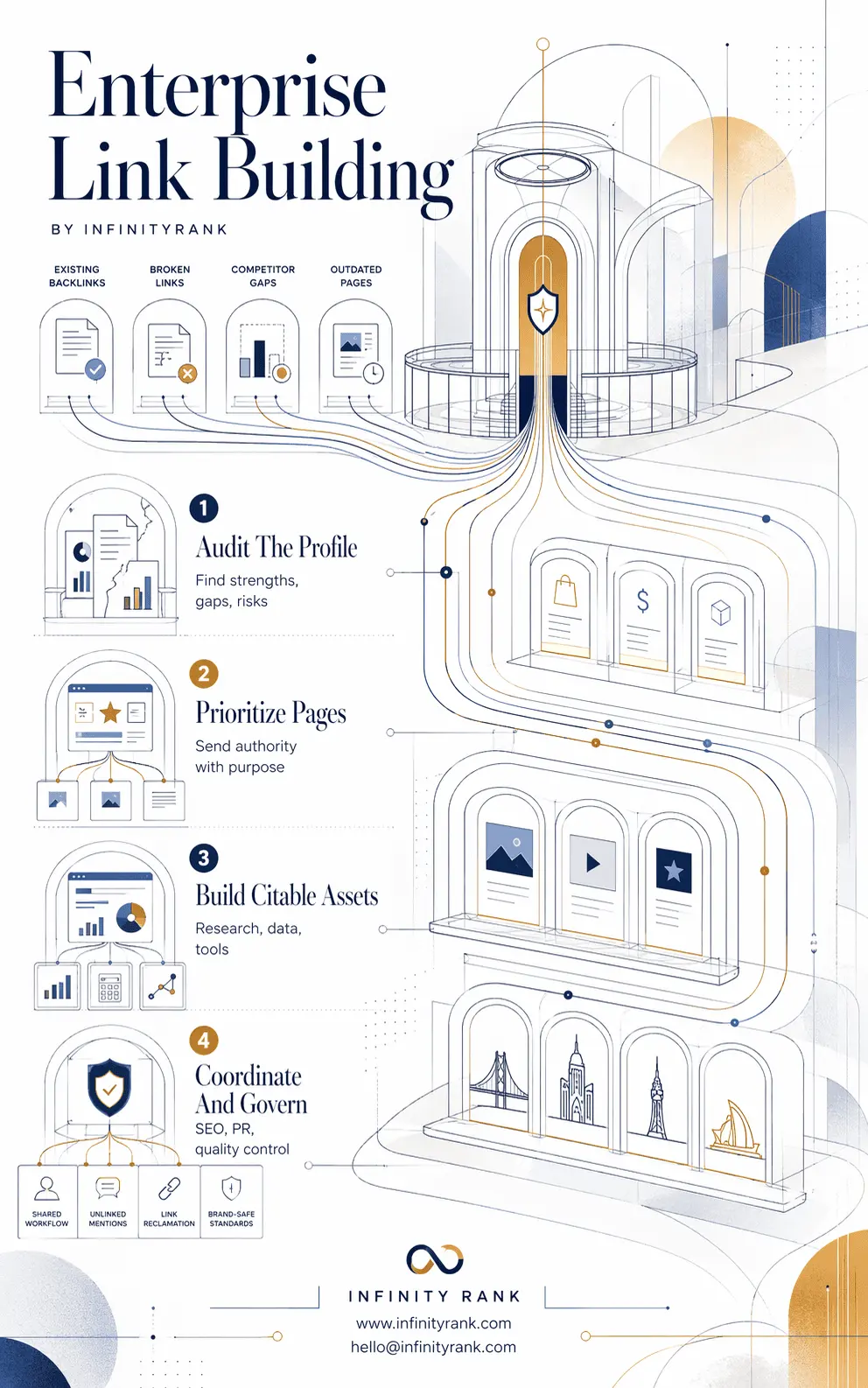
This framework helps brands stop chasing random links and focus on real authority growth. From checking existing backlinks to creating valuable assets and aligning SEO with PR, every step helps improve rankings and build stronger search visibility.
Enterprise Link Building vs. Standard Link Building
| Area | Standard Link Building | Enterprise Link Building |
| Website size | Small or mid-sized site | Hundreds to thousands of URLs |
| Team structure | SEO owner or small marketing team | SEO, PR, content, legal, brand, product, regions |
| Risk level | Lower brand exposure | Higher brand, legal, and reputation risk |
| Main challenge | Getting enough links | Getting relevant links to the right pages at scale |
| Content assets | Blog posts, guides, guest posts | Research reports, data studies, tools, surveys, industry benchmarks |
| Reporting | Links built, domain metrics, rankings | Link quality, page impact, pipeline influence, topic authority, PR value |
| Governance | Informal | Documented process, approvals, risk controls |
This distinction matters. Enterprise link building cannot run on random cold outreach and generic guest posting. Large brands need systems that protect reputation and produce measurable business value.
Step 1: Audit the Existing Backlink Profile
Before launching new campaigns, audit what the brand already has.
Enterprise websites often have years of accumulated backlinks from PR campaigns, old microsites, product launches, partnerships, sponsorships, affiliates, acquisitions, and outdated content. Some links are valuable. Some point to dead pages. Some are irrelevant. Some may create risk.
Start by reviewing:
- Total referring domains
- Links to priority pages
- Links to outdated or redirected URLs
- Broken backlinks pointing to 404 pages
- Link growth patterns
- Anchor text distribution
- Top linked pages
- International or regional link patterns
- Links from low-quality or irrelevant sites
- Competitor backlink gaps
Do not obsess over third-party authority scores alone. Metrics like DA, DR, and Authority Score are useful filters, but they are not Google metrics. They should support judgment, not replace it.
The audit should answer one practical question: which links are helping business-critical pages, and where are the gaps?
Step 2: Define Priority Pages and Topics
A common enterprise mistake is building links without a clear destination strategy.
Not every page deserves direct link building. Some pages are too commercial, too thin, too localized, or too low-priority. Others are perfect targets because they support high-value keywords, product education, or category authority.
Prioritize pages based on:
- Revenue potential
- Keyword difficulty
- Current ranking position
- Conversion value
- Strategic importance
- Internal linking potential
- Existing content quality
- Competitor link gaps
For example, a SaaS company may prioritize links to comparison pages, industry reports, integration pages, and product category pages. A global ecommerce brand may prioritize category hubs, buying guides, seasonal campaigns, and original data reports.
The best enterprise strategy usually combines two page types:
- Commercial pages that need authority to rank
- Linkable assets that naturally attract editorial links
The linkable assets earn authority. Internal linking then helps distribute that authority to related commercial pages.
Step 3: Build Linkable Assets Worth Citing
Enterprise brands have one major advantage: access to data, customers, experts, and industry insight. Use it.
Weak link building asks websites to link to average content. Strong enterprise link building creates assets journalists, bloggers, analysts, and industry sites actually want to reference.
The best linkable assets include:
- Original research reports
- Industry benchmark studies
- Customer data analysis
- Interactive calculators
- Free tools
- Trend reports
- Expert roundups with real subject-matter experts
- Data visualizations
- Annual indexes
- State-of-the-industry reports
- Glossaries and technical explainers
- Statistics pages that are updated regularly
Digital PR is especially useful here because it connects link building with newsworthy content. Semrush defines digital PR as online public relations focused on building brand visibility and reputation through media coverage, backlinks, and positive mentions.
For enterprise brands, the best linkable assets usually come from internal knowledge the market cannot easily copy. Generic blog posts rarely earn strong links. Proprietary data does.
Step 4: Coordinate SEO and PR
Enterprise brands often already earn media mentions. The problem is that SEO teams do not always benefit from them.
PR may secure coverage without a backlink. SEO may run outreach without knowing what PR is pitching. Regional teams may contact the same publication twice. Product teams may launch reports without tracking links. This is wasted authority.
Fix this by creating a shared SEO-PR workflow.
At minimum, the workflow should define:
- Which campaigns need SEO input before launch
- Which URLs should be linked in press materials
- How to request links from unlinked coverage
- Which anchor text is acceptable
- Which pages should never be used in outreach
- Who approves journalist pitches
- How links are tracked after coverage goes live
The goal is not to force journalists to link unnaturally. The goal is to make sure your campaigns include useful, relevant destination pages that deserve citation.
Step 5: Use Unlinked Brand Mentions
Large brands are often mentioned online without being linked. These are usually the easiest link opportunities because the publisher already knows the brand.
Unlinked mention outreach works best when the mention is recent, relevant, and clearly connected to a page that helps readers.
Good targets include:
- News articles mentioning the brand
- Product reviews
- Partner pages
- Event recaps
- Podcast show notes
- Research citations
- Award announcements
- Supplier or customer stories
The outreach should be simple. Do not beg. Do not overexplain. Ask the publisher to add a helpful link so readers can find the referenced source, report, tool, or product page.
This tactic is clean, scalable, and brand-safe when handled properly.
Step 6: Reclaim Lost and Broken Links
Enterprise websites change constantly. Pages are redesigned, merged, redirected, migrated, localized, or removed. That creates broken backlinks.
Link reclamation finds existing backlinks that no longer pass value because they point to:
- 404 pages
- Incorrect URLs
- Old campaign pages
- Redirect chains
- HTTP versions
- Retired microsites
- Non-canonical pages
- Deleted PDFs
This is often faster than earning new links because the link already exists. The fix may be a redirect, page restoration, canonical cleanup, or publisher outreach.
Every enterprise backlink audit should include lost link recovery. Ignoring it means leaking authority you already earned.
Step 7: Create a Link Quality Checklist
Enterprise link building needs quality control. Without it, teams chase volume and report numbers that do not matter.
Use a checklist before counting a link as valuable.
A strong enterprise backlink should usually meet most of these criteria:
- The linking site is topically relevant
- The page is indexed
- The content is editorial, not paid link spam
- The link is placed naturally in the body content
- The anchor text is branded, natural, or contextually relevant
- The page has real traffic or audience value
- The site has editorial standards
- The link is not part of a link farm or private blog network
- The surrounding content makes sense
- The link points to the most relevant URL
- The link does not use manipulative exact-match anchor text
- Sponsored or paid relationships are properly qualified
Google says paid links, affiliate links, and other commercial relationships should be qualified with the correct rel attributes, such as sponsored or nofollow.
That matters. Enterprise brands cannot afford sloppy link practices that put rankings and reputation at risk.
Step 8: Avoid Enterprise Link Building Risks
Bad link building is not just ineffective. It can create real SEO risk.
Avoid:
- Buying links that pass ranking signals
- Using private blog networks
- Overusing exact-match anchors
- Publishing low-quality guest posts at scale
- Building links from irrelevant sites
- Using fake author profiles
- Paying for “guaranteed DA 70 links”
- Relying on link farms
- Creating doorway pages for link acquisition
- Hiding sponsored relationships
- Measuring success only by link volume
Google defines link spam as creating links to or from a site primarily to manipulate search rankings. That includes buying or selling links for ranking purposes, excessive link exchanges, and automated link creation.
For enterprise brands, the safer standard is this: if the link would be embarrassing to show your PR, legal, or executive team, do not build it.
Step 9: Measure the Right KPIs
Enterprise link building reporting should go beyond “we built 40 links this month.”
That metric is too shallow. It encourages volume over quality.
Track metrics in four layers.
Link Quality Metrics
- Referring domains
- Link relevance
- Placement type
- Anchor text mix
- Follow vs. nofollow/sponsored
- Link destination
- New vs. reclaimed links
- Links from authoritative publications
SEO Performance Metrics
- Ranking movement for priority keywords
- Organic traffic to linked pages
- Organic traffic to internally linked commercial pages
- Indexed pages
- Crawl activity
- Share of voice
- Competitor link gap movement
Business Metrics
- Assisted conversions
- Demo requests
- Sales-qualified leads
- Revenue influenced
- Referral traffic quality
- Pipeline contribution
Brand and AI Visibility Metrics
- Brand mentions
- Media coverage
- Citations in AI search tools
- Share of voice in AI-generated answers
- Sentiment of third-party mentions
This matters because AI search visibility is increasingly tied to off-site brand signals, not just traditional blue-link rankings. Semrush’s AI search research says backlinks remain relevant, but quality and authority matter more than raw volume.
The best reporting connects links to visibility, authority, and business outcomes.
Enterprise Link Building Tactics That Work
Original Research Campaigns
Publish data competitors cannot easily replicate. This can include customer behavior trends, industry benchmarks, pricing studies, survey data, or platform usage insights.
Digital PR Campaigns
Turn research, expert commentary, or company data into media-worthy stories. Pitch journalists with clear angles, not generic “please link to us” emails.
Unlinked Brand Mentions
Find existing brand mentions and request a link where it genuinely helps readers.
Broken Link Building
Find broken links on relevant websites and suggest your resource as a replacement. This works best when your content is genuinely useful and closely matches the dead resource.
Link Reclamation
Recover links lost through migrations, redirects, deleted pages, or outdated URLs.
Partner and Supplier Links
Review legitimate relationships with vendors, associations, clients, integrations, sponsorships, and industry groups. Do not force keyword-rich anchors. Keep it natural and accurate.
Executive Thought Leadership
Use expert commentary from founders, executives, researchers, and technical leaders to earn citations in industry publications.
Statistics and Glossary Pages
Well-maintained statistics pages, glossaries, and technical explainers can earn passive links if they are accurate, updated, and better than competing resources.
Common Enterprise Link Building Challenges
Siloed Teams
SEO, PR, content, and brand teams often work separately. This causes duplicated outreach and missed link opportunities.
Fix: Create one shared campaign calendar and one backlink tracking system.
Too Many Target Pages
Large sites make prioritization difficult.
Fix: Build links to strategic assets first, then use internal links to support commercial pages.
Legal and Brand Review Delays
Enterprise approval workflows can slow campaigns.
Fix: Pre-approve outreach templates, link policies, and acceptable claims before campaigns launch.
Weak Content Assets
Large brands often publish polished but generic content.
Fix: Use proprietary data, expert insight, and original research. Design alone does not earn links.
Reporting That Executives Ignore
Executives do not care about “DA links” in isolation.
Fix: Report visibility, rankings, pipeline influence, and competitive movement.
How Long Does Enterprise Link Building Take?
Most enterprise link building campaigns need at least three to six months before meaningful SEO impact becomes visible. Competitive industries may take longer.
The timeline depends on:
- Website authority
- Content quality
- Competition level
- Technical SEO health
- Internal linking
- Campaign quality
- Outreach efficiency
- Search demand
- Existing backlink profile
Fast wins usually come from link reclamation, broken backlink fixes, and unlinked brand mentions. Bigger gains usually come from original research, digital PR, and consistent authority building over time.
Do not promise instant rankings. That is not how enterprise SEO works.
Final Thoughts
Enterprise link building is not about chasing random backlinks. It is about building a reliable system for earning credible, relevant links that support search visibility, brand authority, and business growth.
The strongest enterprise programs combine SEO, PR, content, data, and governance. They create assets worth citing. They avoid manipulative tactics. They track quality instead of vanity metrics. They use internal linking to distribute authority across complex websites.
If your brand already earns attention, the next step is making that attention work harder for search.
Need enterprise link building support? Book a strategy call with Infinity Rank.
Frequently Asked Questions
What is enterprise link building?
Enterprise link building is the process of earning backlinks at scale for large organizations with complex websites, multiple teams, and higher brand-risk considerations.
How is enterprise link building different from normal link building?
Standard link building usually focuses on a smaller site and fewer pages. Enterprise link building requires governance, PR coordination, stakeholder approvals, link quality controls, and reporting across many URLs and teams.
What types of content earn the best enterprise backlinks?
Original research, industry reports, benchmark studies, free tools, expert guides, statistics pages, and data visualizations usually perform best because they give publishers something useful to cite.
Are paid links safe for enterprise SEO?
Paid links that pass ranking signals are risky. Google says paid or sponsored links should be qualified with attributes such as rel="sponsored" or rel="nofollow".
How long does enterprise link building take?
Most campaigns need three to six months to show measurable SEO impact, depending on competition, site authority, content quality, and technical SEO health.
What should enterprise brands track?
Track link relevance, referring domains, anchor text, linked pages, ranking movement, organic traffic, conversions, media mentions, AI search citations, and business impact.