Getting more organic traffic is not about publishing random blog posts and hoping Google rewards you. That strategy is dead.
If you want to boost SEO organic traffic now, you need a system: better keyword targeting, stronger content, clean technical SEO, useful internal links, authority-building backlinks, and pages that answer real search intent better than your competitors.
Google’s own SEO guidance is clear: SEO is about helping search engines understand your content and helping users decide whether your site is worth visiting. There are no shortcuts that automatically rank a page first. The work is still fundamentals, but the execution has to be sharper.
This guide gives you a practical roadmap to increase organic traffic without wasting months on low-impact tasks.
Why Organic Traffic Is Harder Now
Organic SEO is more competitive than it used to be.
Search results are crowded with ads, map packs, product results, videos, featured snippets, forums, AI Overviews, and large authority sites. You are not just competing against other blogs anymore. You are competing against every format Google can show on the results page.
AI search also changes how people discover information. Google says the same SEO fundamentals still apply to AI Overviews and AI Mode, but pages need to be crawlable, indexable, useful, internally linked, and clear enough for users and search systems to understand.
That means generic content is not enough. You need content that is useful, specific, current, and easy to verify.
Quick Wins to Boost SEO Organic Traffic
| Strategy | Difficulty | Timeline | Best For |
| Refresh declining pages | Low | 2–6 weeks | Sites with old blog content |
| Improve title tags and meta descriptions | Low | 1–4 weeks | Pages with impressions but low CTR |
| Add internal links to priority pages | Low | 2–4 weeks | Sites with existing content |
| Fix indexing and crawl issues | Medium | 2–8 weeks | Sites with technical problems |
| Fill keyword gaps | Medium | 1–3 months | Sites losing traffic to competitors |
| Build topical clusters | Medium | 3–6 months | Sites trying to own a niche |
| Earn quality backlinks | Hard | 3–12 months | Competitive keywords |
| Improve Core Web Vitals | Medium/Hard | 1–3 months | Slow or unstable sites |
| Add structured data where relevant | Medium | 2–6 weeks | FAQ, article, product, service pages |
| Track traffic drops properly | Low | Ongoing | Any site relying on SEO |
The Roadmap to Sustainable Organic Growth
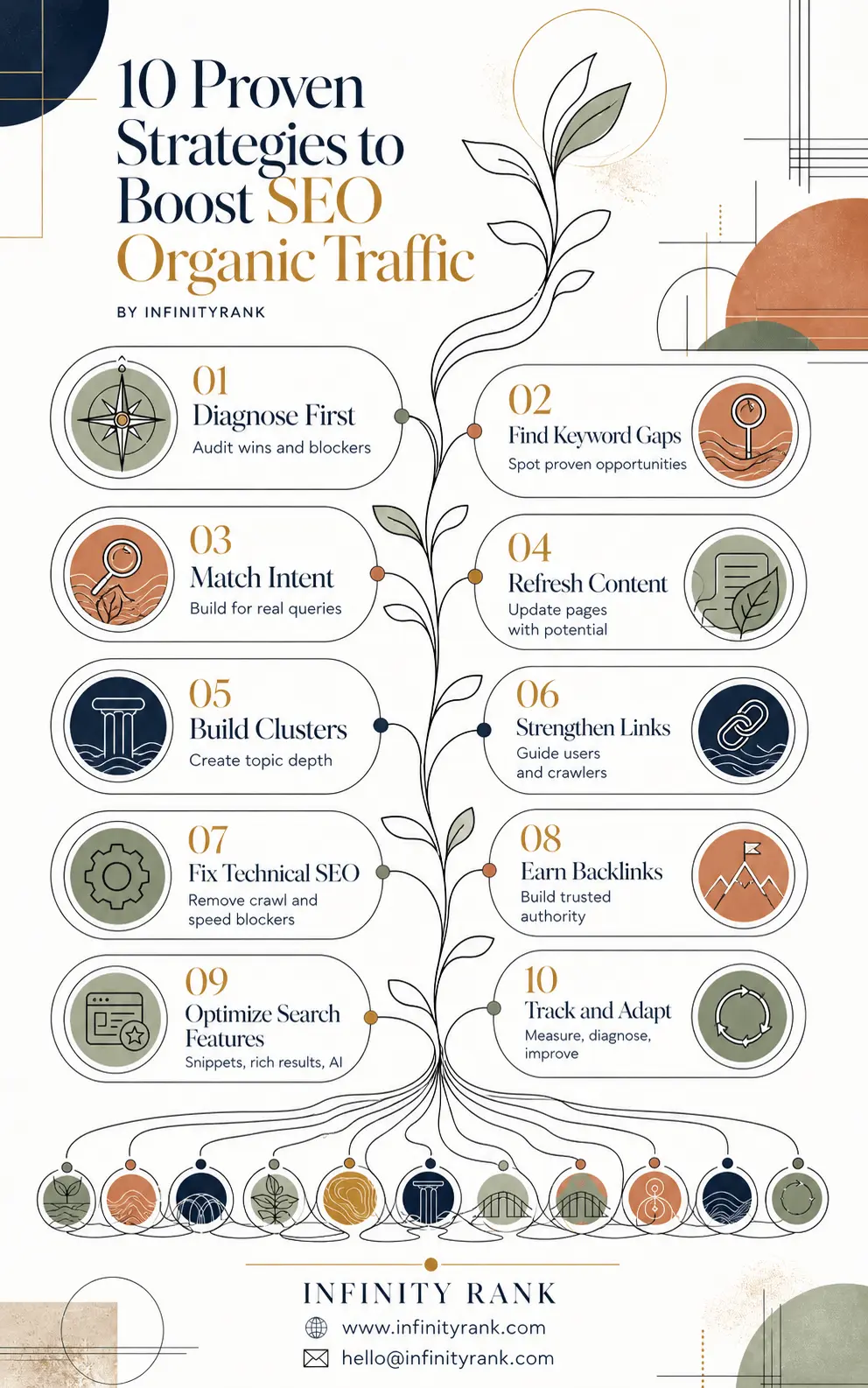
So many people burn their budget on fancy tools and “magic” services without a clear plan, only to end up with flat results and a lot of frustration. This roadmap simplifies the chaos into five clear stages, helping you stop guessing and start focusing on the specific moves that turn a quiet website into a high-traffic asset.
1. Start With an Organic Traffic Growth Roadmap
Do not start with content. Start with diagnosis.
Before writing another article, check where your site already stands. Most SEO campaigns fail because they chase new keywords while ignoring easier wins already sitting inside Google Search Console.
Start with these checks:
- Which pages already get impressions but low clicks?
- Which pages rank between positions 4–20?
- Which pages lost traffic in the last 3–12 months?
- Which important pages are not indexed?
- Which content is outdated, thin, duplicated, or misaligned with search intent?
- Which pages have backlinks but weak rankings?
- Which topics do competitors cover better than you?
Use Google Search Console, Google Analytics, Ahrefs, Semrush, Screaming Frog, and PageSpeed Insights. You do not need every tool. You do need clean data.
A simple roadmap should include:
| Priority | Task | Why It Matters |
| First | Fix indexing and crawl problems | Pages cannot rank if Google cannot access or understand them |
| Second | Refresh pages with declining traffic | Existing URLs usually recover faster than new URLs rank |
| Third | Improve titles and intros | Better CTR and clearer intent matching |
| Fourth | Add internal links | Helps users and search engines find priority pages |
| Fifth | Build missing content | Fills keyword and topical gaps |
| Sixth | Earn backlinks | Needed for competitive topics |
2. Find and Fill Keyword Gaps
Keyword gaps show where competitors rank and you do not. This is one of the fastest ways to find content opportunities because the search demand is already proven.
Do not just copy competitor keywords. That is lazy. Use keyword gaps to find patterns.
Look for:
- Keywords where multiple competitors rank but you do not
- Terms where your page ranks on page two
- Subtopics missing from your existing guide
- Commercial keywords your informational content fails to support
- Questions that appear in People Also Ask or AI-generated summaries
- Keywords with weak competing pages you can beat
Example:
| Competitor Keyword | Search Intent | Your Problem | Fix |
| “organic traffic growth strategy” | Informational | No dedicated section | Add roadmap section |
| “why did my organic traffic drop” | Problem-solving | FAQ only | Create full diagnostic section |
| “increase organic keywords” | Tactical | Mentioned briefly | Add keyword gap workflow |
| “SEO content refresh checklist” | Practical | Missing | Add checklist/table |
The goal is not more keywords. The goal is more useful coverage of the topic.
3. Match Search Intent Before Writing Anything
Search intent is the reason behind the query.
Someone searching “what is organic traffic” needs a definition. Someone searching “how to increase organic traffic” wants tactics. Someone searching “organic traffic dropped suddenly” needs a troubleshooting process. Treating all three searches the same creates weak content.
Before targeting a keyword, review the current search results and ask:
- Are the top results guides, tools, service pages, listicles, videos, or product pages?
- Are users looking for beginner advice or advanced execution?
- Are the ranking pages short explanations or deep tutorials?
- Do results include templates, checklists, screenshots, examples, or data?
- Is the query informational, commercial, transactional, or navigational?
Then build the page to match the intent.
For this article, the intent is practical. Readers want to know what to do to increase organic traffic. That means this page needs tactics, examples, prioritization, and diagnostics — not motivational SEO fluff.
4. Refresh Existing Content Before Publishing More
Most sites do not need more content first. They need better content.
Old pages often lose traffic because rankings decay, search intent changes, competitors improve their content, data becomes outdated, or Google starts showing new SERP features.
Refresh pages that have:
- Falling clicks
- Stable impressions but lower CTR
- Rankings slipping from top 3 to positions 5–15
- Outdated dates, screenshots, pricing, tools, or examples
- Thin sections compared with current competitors
- Missing FAQs or subtopics
- Weak internal links
- Poor title tags
A proper content refresh includes:
- Rewrite the intro to match current search intent.
- Update outdated facts, tools, screenshots, and examples.
- Add missing subtopics from competitor analysis.
- Improve headings so the article is easier to scan.
- Add internal links from relevant older posts.
- Add external citations where claims need proof.
- Improve the title tag and meta description.
- Add or update schema if relevant.
- Re-submit the URL in Search Console after major changes.
Google’s helpful content guidance focuses on useful, reliable content made for people, not content created only to manipulate rankings. It also recommends checking whether content provides original value, complete coverage, clear sourcing, and evidence of expertise.
That is the standard your refreshes need to meet.
5. Build Topical Authority With Content Clusters
Random blog posts do not build authority. Connected content does.
A topical cluster is a group of pages that cover a main subject in depth. One pillar page targets the broad topic. Supporting pages cover specific subtopics and link back to the pillar.
Example for an SEO agency:
| Pillar Page | Supporting Pages |
| SEO Strategy | Keyword research, technical SEO, topical maps, content refreshes, link building, SEO reporting |
| Link Building | Guest posting, digital PR, SaaS link building, ecommerce backlinks, HARO alternatives |
| Content Marketing | SEO blog writing, content briefs, content audits, content gap analysis, AI content workflows |
The structure matters because it helps users find related answers and helps search engines understand how your expertise is organized. Google also specifically recommends making content easy to find through internal links.
Use this internal linking pattern:
- Pillar page links to every important supporting page.
- Supporting pages link back to the pillar.
- Supporting pages link to each other where contextually relevant.
- High-authority pages link to high-priority commercial pages.
- Anchor text describes the destination page clearly.
Bad anchor text: “click here”
Better anchor text: “technical SEO audit checklist”
6. Strengthen Internal Links
Internal links are one of the most underused SEO levers because they are boring. That does not make them optional.
Good internal links help:
- Search engines discover deeper pages
- Users move through related content
- Important pages receive more internal authority
- Topic clusters become clearer
- Orphan pages get crawled and indexed
Start with these pages:
- Your homepage
- High-traffic blog posts
- Pages with backlinks
- Top-ranking informational articles
- Service pages that need more authority
- Content hubs and category pages
Add internal links from relevant pages to:
- Revenue-driving service pages
- High-value guides
- Pages stuck on page two
- Freshly updated content
- New cluster pages
Keep the links natural. Do not force 20 exact-match anchors into every post. That looks spammy and reads badly.
A useful rule: every important page should have at least 3–10 relevant internal links pointing to it, depending on site size and topic importance.
7. Fix Technical SEO and Core Web Vitals
Technical SEO will not save bad content. But bad technical SEO can bury good content.
Check these issues first:
- Pages blocked by robots.txt
- Accidental noindex tags
- Broken canonical tags
- Redirect chains
- 404 pages with backlinks
- Duplicate pages
- Poor mobile usability
- Slow templates
- Missing XML sitemap URLs
- Broken internal links
- JavaScript-rendered content Google cannot access
- Thin tag/category pages indexed unnecessarily
Also check Core Web Vitals. Core Web Vitals measure loading, interactivity, and visual stability through LCP, INP, and CLS. Google’s Web Vitals documentation says these metrics apply to all web pages and should be measured by site owners.
Focus on:
| Metric | What It Measures | Common Fixes |
| LCP | Main content loading speed | Compress images, improve hosting, reduce render-blocking scripts |
| INP | Responsiveness to user interaction | Reduce JavaScript bloat, optimize event handlers |
| CLS | Visual stability | Set image dimensions, avoid layout shifts, reserve ad/widget space |
Use Search Console’s Core Web Vitals report to find groups of poor URLs. Google says the report groups URL performance by status, metric type, and similar URL groups using real user data.
Do not obsess over a perfect score. Fix issues that affect important templates and real users.
8. Earn Better Backlinks and Brand Mentions
Backlinks still matter, but low-quality link building is a liability.
The goal is not to collect random links. The goal is to earn relevant, trusted links that make sense for your niche.
Strong backlink tactics include:
- Digital PR campaigns
- Original data studies
- Expert quotes
- Guest posts on relevant industry sites
- Linkable assets
- Resource page outreach
- Podcast appearances
- Unlinked brand mention reclamation
- Broken link building
- Case studies with shareable results
Weak backlink tactics include:
- Spammy guest post farms
- Irrelevant niche edits
- Private blog networks
- AI-generated outreach at scale
- Exact-match anchor abuse
- Links from sites with no real audience
If you are in a competitive niche, backlinks are often the difference between decent content that sits on page two and strong content that breaks into the top results.
But do not build links to weak pages. Fix the page first. Then promote it.
9. Optimize for Featured Snippets, Rich Results, and AI Search
Search is no longer just ten blue links. Your content has to work for snippets, AI-generated answers, and traditional rankings.
To improve visibility:
- Answer the main question clearly near the top.
- Use short definitions for “what is” queries.
- Use numbered steps for process queries.
- Use tables for comparisons.
- Use bullet lists for checklists.
- Add original examples.
- Keep headings descriptive.
- Make the page easy to scan.
- Support claims with credible sources.
- Make sure important content is visible as text, not trapped inside images.
Structured data can help search engines understand page content, but it does not guarantee rich results. Google describes structured data as a standardized format for classifying page content, and also states that features using structured data are not guaranteed to appear in search results.
Use schema only when it matches the visible content.
Relevant schema types may include:
- Article
- FAQPage
- BreadcrumbList
- Organization
- LocalBusiness
- Product
- Service
- Review, only when guidelines are met
Example FAQ schema:
<script type="application/ld+json">
{
  "@context": "https://schema.org",
  "@type": "FAQPage",
  "mainEntity": [
    {
      "@type": "Question",
      "name": "How can I increase organic traffic?",
      "acceptedAnswer": {
        "@type": "Answer",
        "text": "Start by fixing technical SEO issues, refreshing declining pages, filling keyword gaps, improving internal links, matching search intent, and earning relevant backlinks."
      }
    },
    {
      "@type": "Question",
      "name": "How long does SEO take to increase organic traffic?",
      "acceptedAnswer": {
        "@type": "Answer",
        "text": "Some fixes can improve visibility within weeks, but meaningful organic traffic growth usually takes several months, depending on competition, site authority, content quality, and technical health."
      }
    }
  ]
}
</script>
10. Track, Diagnose, and Adapt
SEO is not a one-time project. It is maintenance.
Check performance weekly or monthly depending on site size. Do not panic over one bad day. Look for patterns.
Track:
- Organic clicks
- Organic impressions
- CTR
- Average position
- Indexed pages
- Top gaining pages
- Top losing pages
- Keyword movement
- Conversion rate from organic traffic
- Assisted conversions
- Backlink growth/loss
- Core Web Vitals status
When organic traffic drops, diagnose before changing anything.
Common causes include:
| Problem | What to Check |
| Algorithm update | Compare drop date with Google update history |
| Seasonality | Compare year-over-year traffic |
| Indexing issue | Check URL Inspection and Coverage reports |
| Lost rankings | Review keyword position changes |
| Lost backlinks | Check referring domains and link losses |
| Content decay | Compare your page with newer competitors |
| Technical change | Review redirects, canonicals, noindex tags, robots.txt |
| SERP change | Check if ads, snippets, AI Overviews, or map packs changed clicks |
| Tracking issue | Verify GA4, tags, and Search Console data |
Do not rewrite everything blindly. Fix the actual cause.
30/60/90-Day Organic Traffic Growth Plan
First 30 Days: Fix and Prioritize
Focus on diagnosis and quick wins.
- Audit Search Console data.
- Find pages with high impressions and low CTR.
- Identify rankings in positions 4–20.
- Check indexing problems.
- Fix broken internal links.
- Improve title tags and meta descriptions.
- Refresh 3–5 declining pages.
- Add internal links to priority service pages.
- Run a crawl to find technical problems.
Days 31–60: Build and Improve
Now improve content depth and structure.
- Build a keyword gap list.
- Create or update content briefs.
- Improve thin pages.
- Add missing FAQs and examples.
- Build topic clusters.
- Add schema where useful.
- Improve Core Web Vitals on key templates.
- Reclaim lost backlinks.
- Start outreach for linkable assets.
Days 61–90: Scale What Works
Double down on pages and topics showing traction.
- Publish supporting cluster pages.
- Build backlinks to priority assets.
- Update internal links across older posts.
- Compare traffic and ranking movement.
- Improve conversion paths on high-traffic pages.
- Refresh pages still stuck on page two.
- Document repeatable SEO SOPs.
What to Do If Your Organic Traffic Dropped
A drop in organic traffic does not always mean your SEO strategy failed.
First, check whether the drop is real. GA4 tracking problems, tag changes, consent banners, or reporting delays can make traffic look worse than it is.
Then check Search Console.
Ask:
- Did clicks drop, or only impressions?
- Did CTR drop while impressions stayed stable?
- Did rankings fall for specific pages?
- Did one page lose traffic, or did the whole site drop?
- Did branded traffic decline?
- Did Google stop indexing important URLs?
- Did competitors publish stronger pages?
- Did search results add AI Overviews, ads, videos, or map packs?
- Did backlinks disappear?
- Did the site recently migrate, redesign, or change URLs?
Match the fix to the cause.
If rankings dropped because the content is outdated, refresh the page.
If clicks dropped but rankings stayed stable, rewrite the title and meta description.
If impressions dropped across many pages, check indexing, technical changes, and algorithm timing.
If a few pages lose links, reclaim or replace the links.
If competitors improve their content, close the content gap.
Final Thoughts
The best way to boost SEO organic traffic is to stop treating SEO like a checklist.
You need a repeatable system:
- Diagnose the current site.
- Fix technical blockers.
- Refresh pages that already have potential.
- Fill keyword and content gaps.
- Build topic clusters.
- Strengthen internal links.
- Earn relevant backlinks.
- Optimize for snippets, AI search, and rich results.
- Track results.
- Keep improving.
SEO still compounds, but only when the work is focused. Random content and random backlinks will not build lasting organic traffic.
Need a cleaner starting point? Run an SEO audit first. Find the pages closest to ranking, fix the pages already losing traffic, and build from there.
Frequently Asked Questions
How long does it take to increase organic traffic?
Small improvements can show within a few weeks, especially title updates, content refreshes, and internal linking changes. Bigger gains usually take several months because Google needs time to crawl, process, and evaluate changes. Competitive niches take longer.
What is the fastest way to boost SEO organic traffic?
The fastest path is usually refreshing existing pages that already rank or used to rank. New content takes longer. Existing URLs with impressions, backlinks, or page-two rankings often respond faster.
How do I increase organic keywords?
Use keyword gap analysis, expand thin sections, add missing subtopics, create supporting cluster pages, and improve internal links. Do not chase irrelevant keywords. More keywords only matter if they attract the right audience.
Why did my organic traffic drop?
Common causes include algorithm updates, seasonality, technical errors, indexing problems, content decay, lost backlinks, tracking issues, or changes in the search results page. Check Search Console before making major edits.
Are backlinks still important for organic traffic?
Yes, especially in competitive niches. But relevance and quality matter more than volume. A few strong links from trusted, relevant sites are better than dozens of weak links from unrelated sites.
Does schema markup improve rankings?
Schema markup does not directly guarantee rankings or rich results. It helps search engines understand page content and can make pages eligible for enhanced search features when implemented correctly. Google does not guarantee that structured data features will appear.